
John 1
Estimated time to read:
Read this article to me
Suggested prerequisite reading:
Book Study Intro Note
Study References, Resources, and Acknowledgments
Supporting Articles:
This John 1 commentary examines Jesus Christ as the eternal Word of God, His role in creation, His incarnation, and the revelation of His divine identity through the testimony of John the Baptist.
The Living Word of God: From the Beginning to the True Light
Understanding the eternal Word, His work in creation, and the revelation of God in Jesus Christ
Introduction: Have We Underestimated the Word of God?
When we speak of the Word of God, we often think immediately of the Bible, the preaching of the Gospel, or the words spoken by the prophets and apostles. These are important expressions of God’s revelation. But John begins his Gospel by directing our attention beyond every written document and every human voice. He introduces us to the Word who already existed in the beginning, who was with God, and who was God. Before we consider what God has said to humanity, we must consider what John reveals about the Word Himself.
John’s opening words are not accidental. They invite us to return to Genesis, where God creates and where the repeated declaration “And God said” introduces His commands. What connection should we recognize between the Word John describes and the Word through which God accomplishes His purposes in Genesis? And when John later speaks of life and light, should we hear another echo of the opening chapter of Scripture? These questions deserve careful consideration, but in the order John presents them.
John 1:1
“In the beginning was the Word, and the Word was with God, and the Word was God.” (John 1:1, KJV)
The Beginning of Creation Was Not the Beginning of the Word
Genesis begins, “In the beginning God created the heaven and the earth” (Genesis 1:1). John begins with the same words, “In the beginning,” but instead of first describing what God created, he tells us who already existed. The distinction is decisive. John does not say that the Word was brought into existence in the beginning. He says that the Word was.
The Greek verb translated “was” is ēn, a form of eimi [G1510], “to be” or “to exist.” John uses it to describe the Word’s existence at the beginning. Later, in John 1:3, he uses a different verb when describing things that came into existence. The contrast becomes even clearer when the verses are read together: the Word already was; created things came to be. John places the Word on the side of the Creator, not among the things created.
What Does John Mean by “the Word”?
The Greek term translated “Word” is Logos [G3056]. Depending on its context, logos can refer to a word, statement, message, account, or reason. John, however, is not merely describing an audible sound, a written sentence, or an impersonal principle. He says the Word was with God and was God. He will later say that all things came into existence through Him (John 1:3), and that the Word became flesh and dwelt among us (John 1:14). John’s own Gospel therefore tells us whom he means: the eternal Word revealed in Jesus Christ.
The expression “with God” should not be passed over, nor should the declaration “was God” be weakened. John affirms both. The Word is not simply another name for the written Scriptures, and He is not a lesser being created to carry out God’s work. John explicitly attributes deity to the Word. We should allow that declaration to stand with its full force.
Should We Connect John’s Word with “And God Said” in Genesis?
Having heard John’s deliberate echo of Genesis 1:1, should we not ask whether there is also a connection between the eternal Word and the repeated statement throughout Genesis that God said something and it was accomplished? Genesis records, “And God said,” again and again. God commands, and His purposes are carried out. John tells us that the Word was already present in the beginning. These are not identical expressions in Hebrew and Greek, and we should not pretend that every reference to God speaking is automatically a direct personal title for Christ. Nevertheless, the biblical connection between God’s Word and His work of creation is unmistakable.
“By the word of the LORD were the heavens made; and all the host of them by the breath of his mouth.” (Psalm 33:6, KJV)
“For he spake, and it was done; he commanded, and it stood fast.” (Psalm 33:9, KJV)
Psalm 33 does not merely say that God informed someone about creation. It describes His Word as effective in accomplishing what He commanded. Hebrews 11:3 similarly teaches that the worlds were framed by the Word of God. John now reveals something further: the Word through whom all created things came into existence already existed with God and was God. This is not an attempt to identify a particular spoken syllable in Genesis as Jesus. It is a recognition that the creative activity of God through His Word prepares us to understand John’s extraordinary declaration about Christ.
Does the Original Greek Say “the Word Was a god”?
Some argue that John 1:1 should describe the Word as “a god” rather than “God,” sometimes appealing to the absence of a capital letter in the original Greek. But that argument misunderstands how the Greek text works. The earliest Greek manuscripts were commonly written in capital letters throughout, without the modern English distinction between an uppercase “God” and a lowercase “god.” 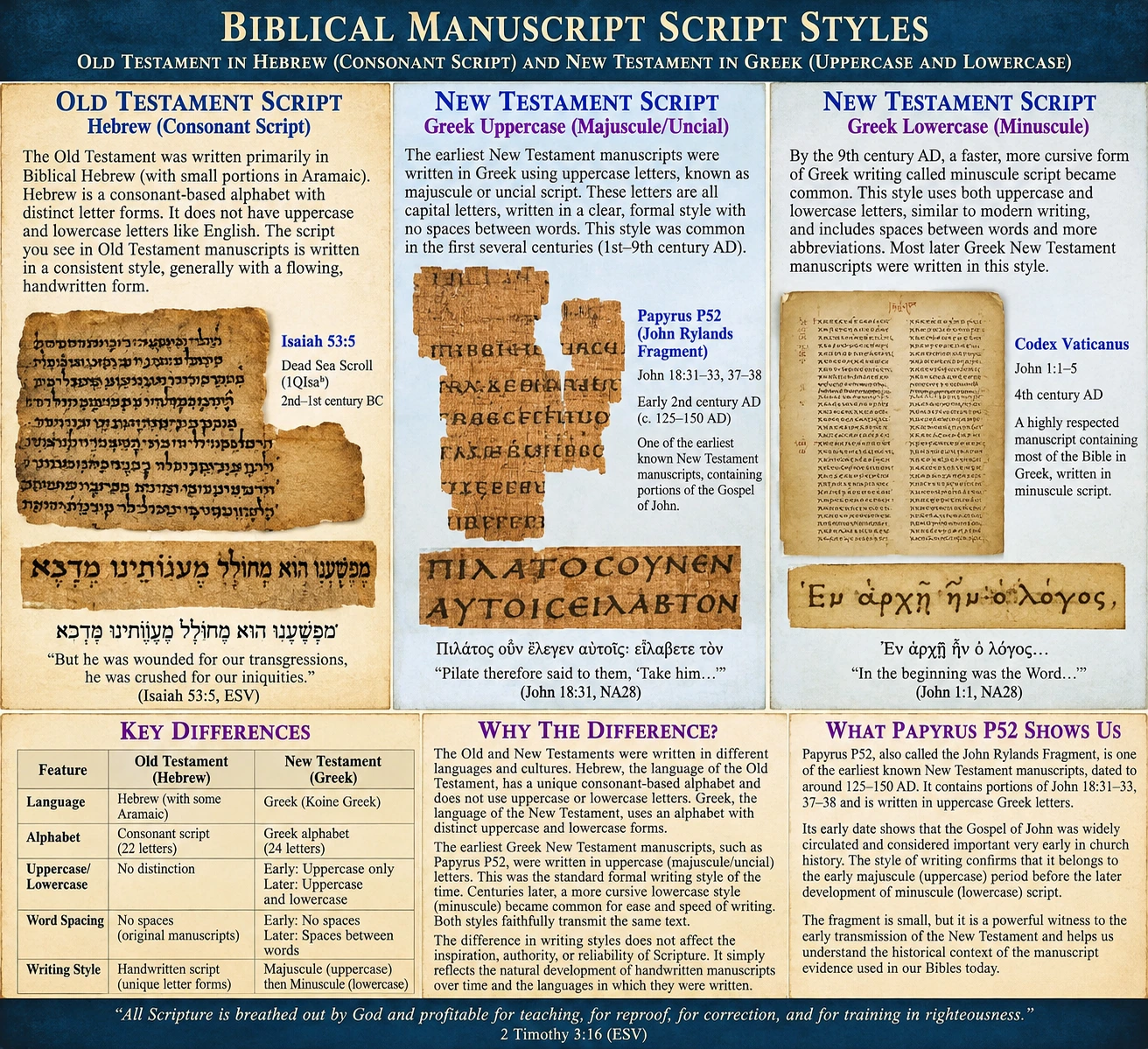 Capitalization therefore cannot settle the meaning of John’s statement. Nor does the absence of the Greek definite article before theos (“God”) automatically turn the word into “a god.” Greek does not use an indefinite article equivalent to the English “a,” and the meaning of a noun must be determined by its grammar and context.
John writes kai theos ēn ho logos—“and the Word was God.” Here theos appears before the verb and describes what the Word was, while ho logos identifies the subject. John has already distinguished the Word as being with God, and he now declares the Word’s deity. His wording does not require us to understand the Word as the same referent as “God” in the preceding phrase, but neither does it make Him a lesser, created god. The declaration must be read alongside John 1:3, which places the Word outside the category of everything that came into existence. The argument for Christ’s deity rests upon John’s words and their context, not upon an English capital letter.
Does God’s Word Depend Upon a Human Voice?
God’s Word is not merely a spoken sound that would fall silent in a vacuum. The eternal Logos is the living Word, in whom is life itself (John 1:4). His power does not depend upon air, sound waves, human language, or anyone being present to hear. When God commands, His will is accomplished. Indeed, the power of His Word is such that even what does not yet exist can be brought into existence through Him. As Hebrews 11:3 teaches, the things which are seen were not made of things which do appear. John tells us why we must not mistake this Word for a mere created sound or message: the Word already was, the Word was God, and all things that came into existence came into existence through Him (John 1:1–3).
John 1:2–3
“The same was in the beginning with God. All things were made by him; and without him was not any thing made that was made.”
Everything Created Came into Existence Through Him
John repeats that the Word was in the beginning with God, and then makes a sweeping declaration about creation: all things were made through Him. John does not leave room for a second class of created things that somehow came into existence apart from the Word. He reinforces the statement negatively: without Him, not even one thing that came into existence came into existence.
The Greek expression translated “were made” uses egeneto, from ginomai [G1096], meaning “to become,” “to happen,” or “to come into existence.” Compare this with the Word who already was in John 1:1. John is distinguishing the eternal existence of the Word from the coming into existence of created things.
Consider the implication. If the Word Himself had been created, He would belong to the very category of things John says came into existence through Him. Yet John states that without Him was not any thing made that was made. Christ cannot be placed among created things without contradicting the distinction John has just made. He is not the first created thing; He is the eternal Word through whom all created things came into existence.
This conclusion is also consistent with Colossians 1:16–17, which describes all things as created through Christ and for Him, and declares that He is before all things. Hebrews 1:2–3 likewise associates the Son with creation and the sustaining of all things. These passages reinforce, rather than replace, what John himself has already established.
John 1:4–5
“In him was life; and the life was the light of men. And the light shineth in darkness; and the darkness comprehended it not.”
In Him Was Life, and the Life Was the Light of Men
Only now does John introduce the language of life and light. Notice his order. He first identifies the Word as eternal and divine. He then identifies Him as the One through whom all created things came into existence. Now he tells us that in Him was life, and that this life was the light of humanity. The light John describes is not merely a beam of physical illumination. As the Gospel unfolds, light is associated with God’s revelation, truth, life, and the coming of Christ into a world marked by darkness (John 1:9; 3:19–21; 8:12).
Is There a Connection Between John’s Light and the Light of Genesis?
John has already taken us back to Genesis with the words “In the beginning.” He has introduced the eternal Word through whom all things were made. When he now speaks of light shining in darkness, it is reasonable to ask whether he intends us to remember the opening creation account once again. Genesis 1:2 describes darkness over the face of the deep; Genesis 1:3 then records God’s command concerning light.
(Genesis 1:3) “And God said, Let there be light: and there was light.”
What exactly does Genesis mean by “Let there be light”? Is the verse necessarily describing the first creation of physical light or energy from nothing? Could it describe light becoming manifest within the created world? And might Scripture also invite us to recognize a deeper connection between God’s creative command and the light of His revelation? These questions are worth exploring, but we must distinguish what the text states from the possibilities we draw from it.
What Does “Let There Be Light” Actually Say?
The Hebrew expression is yehi ’or (יְהִי אוֹר). Yehi comes from hayah [H1961], “to be” or “to become,” and ’or [H216] means “light.” The verse does not use the Hebrew verb bara [H1254], “to create.” The absence of bara does not, by itself, prove that light already existed. Equally, the expression “Let there be light” does not, by itself, establish whether light was being created for the first time or something already existing was being made manifest.
It could refer to previously created physical light becoming manifest upon the earth, or it could refer to the radiance of the eternal Word or the Holy Spirit being made manifest upon the earth. It could even involve both, without requiring that both refer to the same kind of light.
The Pattern of God’s Activity Throughout Genesis Chapters 1–2
Genesis 1:1 — God created the heavens and the earth. The Hebrew verb bara [H1254] emphasizes God’s creative act of bringing something new and unique into existence that had never before existed. However, it does not function in every biblical occurrence as a technical term requiring that the material from which something is created must also be created from nothing. For example, God created the heavens and the earth from nothing (ex nihilo), bringing into existence something entirely new and unique. Later, God created the first birds and fish (Genesis 1:20–21), living creatures possessing both bodies and souls. These creatures were likewise new and unique, having never previously existed, yet their bodies were composed of earthly material that God had already created.
To better understand the distinctions between the biblical expressions “created,” “made,” “formed,” and “let there be,” and how these terms are used throughout the creation account, see:
These studies examine the original Hebrew expressions, their meanings, and how God’s work of creating, forming, ordering, and making things manifest contributes to our understanding of the biblical creation account.
Therefore, I am not suggesting that we conclude from the Hebrew alone that Genesis 1:3 refers only to spiritual light, or that physical illumination is excluded. The immediate Genesis narrative describes the separation of light from darkness and the naming of day and night (Genesis 1:4–5). That context gives physical light a natural place in the passage. However, Scripture also uses light to speak of God’s glory, truth, life, and revelation. The question is whether the later biblical writers themselves invite us to recognize a deeper connection between the light of the first creation and the revelation of Christ.
Yet we should not overlook something particularly significant. God is a God who speaks, and He expresses Himself through His eternal, uncreated Word. The same Word through whom God brought life and light to the first creation, when darkness covered the face of the deep and the earth was without form and void, is the Word through whom God now brings spiritual life and light to a fallen humanity living in spiritual darkness. Just as the first creation depended entirely upon God’s Word for its existence and life, so too does the new creation depend entirely upon that same eternal Word for its spiritual life and light (John 1:1–5; 2 Corinthians 4:6; 5:17).
“For God, who commanded the light to shine out of darkness, hath shined in our hearts, to give the light of the knowledge of the glory of God in the face of Jesus Christ.” (2 Corinthians 4:6, KJV)
John’s statement that the light shines in darkness also prepares us for the rest of his Gospel. The darkness does not overcome the light. John will describe people loving darkness rather than light because their deeds were evil (John 3:19–21), and Jesus will declare, “I am the light of the world” (John 8:12). Thus John’s language moves beyond the physical conditions of the first creation to the revelation of God and the response of humanity to Christ. The connection with Genesis is meaningful precisely because John is revealing something greater than a description of sunlight: he is revealing the One in whom life is found.
John 1:6–8
“There was a man sent from God, whose name was John. The same came for a witness, to bear witness of the Light, that all men through him might believe. He was not that Light, but was sent to bear witness of that Light.”
John the Baptist Was Sent to Bear Witness to the Light
John now introduces another person named John—John the Baptist, not the author of the Gospel. The distinction could hardly be clearer. The eternal Word already was in the beginning, but John the Baptist was sent from God. The witness was a man commissioned for a purpose; the Light about whom he testified was the One through whom the world itself was made.
John the Baptist was not the source of the Light, nor was he the object of saving faith. His assignment was to testify to Christ so that people might believe through his witness. Notice that the witness is a means by which people hear the truth; the One to whom that testimony points is Jesus Christ. This distinction will become increasingly important as the chapter proceeds, because John repeatedly refuses to make himself the center of attention.
Why Does God Send a Witness?
God did not send John because the eternal Word needed someone to give Him existence or authority. He sent a witness so that people would recognize the One who had come among them. Later John will say, “Behold the Lamb of God” (John 1:29). His message was not “Look at me,” but “Look at Him.” The very presence of a witness reminds us that the revelation of Christ calls for a response: the testimony is given so that those who hear may believe.
John 1:9–14
“That was the true Light, which lighteth every man that cometh into the world.”
“He was in the world, and the world was made by him, and the world knew him not.”
The True Light Entered the World He Made
John now brings the threads together. The true Light enters the very world that was made through Him. The tragedy is that the world did not recognize Him. John is not describing a created light suddenly becoming divine; he is describing the eternal Word entering the world of His own creation. The light of divine revelation is personal, and John will identify Him unmistakably.
Received or Rejected, and the Right to Become Children of God
“He came unto his own, and his own received him not. But as many as received him, to them gave he power to become the sons of God, even to them that believe on his name: Which were born, not of blood, nor of the will of the flesh, nor of the will of man, but of God.”
John has just said that the world was made through the Word, yet the world did not know Him. He now makes the rejection more personal: Christ came to His own, and His own did not receive Him. The wording points to the tragedy of rejection among those to whom He came, but John does not leave the reader with rejection as the final word. He immediately contrasts it with those who did receive Him.
Notice how John explains receiving Christ: he speaks of those who believe on His name. This is not merely recognizing that a remarkable teacher has appeared. It is receiving the One John has already identified as the eternal Word, the Creator, and the true Light. To such believers Christ gives the right or authority to become children of God. The Greek word translated “power” is exousia [G1849], often expressing authority, right, or privilege. John is not saying that people become divine beings. He is describing the extraordinary privilege of being brought into God’s family.
Verse 13 makes clear that this new birth is of God. It does not arise from ancestry, human descent, or merely a human decision to confer spiritual life upon oneself. John will develop the subject of being born of God more fully when Jesus speaks with Nicodemus in John 3. Here the emphasis is already unmistakable: becoming a child of God is not an inherited status or an achievement of human lineage. It is a gracious relationship established by God and received through faith in Christ.
“And the Word was made flesh, and dwelt among us, (and we beheld his glory, the glory as of the only begotten of the Father,) full of grace and truth.”
Here John resolves any remaining uncertainty about the Word. The eternal Logos became flesh. The verb translated “was made” in this verse is again related to ginomai [G1096], but the meaning must be read in its sentence: the Word became flesh. John is not saying that the Word began to exist. He has already said the opposite. He is declaring that the One who eternally existed as God truly entered human life.
Notice also John’s reference to glory. The Word who was with God and was God became flesh, and His glory was witnessed. The connection with 2 Corinthians 4:6 becomes especially meaningful here: God’s glory is made known in Jesus Christ. The Word who brought the world into existence is also the Word through whom God reveals Himself to the world.
Supplementary Note: John 1:9–13 — Receiving Christ, Believing, and Being Born of God
John describes differing responses to Christ: many did not receive Him, while those receiving Him—those believing in His name—were given the right to become children of God. John then says they were born of God. The passage excludes ancestry, physical descent, and autonomous human achievement as the source of the new birth. It does not explicitly say regeneration occurred before faith or that selected unbelievers were first regenerated so that they would irresistibly believe. Preserve both truths: the new birth originates with God, and John identifies those receiving Christ as those believing in His name.
John 1:15–18
“John bare witness of him, and cried, saying, This was he of whom I spake, He that cometh after me is preferred before me: for he was before me.”
The Eternal Son Makes the Father Known
John the Baptist was born before Jesus in their earthly lives (Luke 1:24–36), yet he declares that Jesus was before him. This is not a contradiction. John is distinguishing the order of their earthly appearance from the greater reality of Christ’s prior existence and superior standing. His testimony fits the opening declaration of this Gospel: the Word did not begin when He became flesh. He already was.
John 1:16–17
“And of his fulness have all we received, and grace for grace. For the law was given by Moses, but grace and truth came by Jesus Christ.”
John now speaks of the fullness found in Christ. The phrase “grace for grace” translates charin anti charitos; it has been understood as grace succeeding grace or grace in place of grace. Either way, the emphasis falls upon the abundance that comes through Jesus Christ. John is not saying that the law given through Moses was evil or that God had previously been without grace. Rather, he is showing that the revelation and provision made known in Jesus Christ surpass what came through Moses. The law was given through a servant; grace and truth have come through the incarnate Word Himself.
John 1:18
“No man hath seen God at any time; the only begotten Son, which is in the bosom of the Father, he hath declared him.”
John concludes this opening section with a remarkable declaration about revelation. The One who became flesh has made God known. The Greek verb translated “declared” is exēgeomai [G1834], meaning to explain, recount, or make known. The Son does not merely deliver a report about someone He has never known. He reveals the Father from a relationship of unique intimacy.
A Significant Textual Difference in
Some Greek manuscripts read “the only begotten Son,” reflected in the KJV, while other early manuscripts read “the only begotten God” or “the unique God.” This is a genuine textual variation and should not be concealed. Neither reading makes the Word a created being. Both identify Jesus as the unique revealer of the Father, and both must be read in the context of John 1:1–3, where the Word already existed and was God. The chapter begins with the eternal Word and concludes its opening testimony with that Word making God known.
John 1:19–28
(John 1:19) “And this is the record of John, when the Jews sent priests and Levites from Jerusalem to ask him, Who art thou?”
John the Baptist Identifies Himself as a Witness
The Gospel now moves from John’s opening explanation to the public testimony of John the Baptist. Religious representatives come from Jerusalem to question him. The expression “the Jews” in this setting refers to the authorities or representatives involved in the inquiry; it should not be taken to mean that every Jewish person opposed Jesus. John the Baptist himself was Jewish, as were Jesus and His first disciples.
(John 1:20) “And he confessed, and denied not; but confessed, I am not the Christ.”
John immediately rules out the most important misunderstanding. He is not the Christ, the Messiah whom Israel awaited. Asked whether he is Elijah or “that prophet,” he answers no (John 1:21). This requires care, since Jesus later speaks of John fulfilling the role associated with Elijah (Matthew 11:14; 17:10–13). John denies being Elijah personally returned in the way his questioners may have expected; his ministry nevertheless fulfills the prophetic preparation associated with Elijah (Luke 1:17).
(John 1:23) “He said, I am the voice of one crying in the wilderness, Make straight the way of the Lord, as said the prophet Esaias.”
John identifies himself using Isaiah 40:3. He is a voice, not the eternal Word. His calling is to prepare the way of the Lord. The distinction is especially fitting in this chapter: the human messenger announces the coming of the divine One. John’s importance rests not in who he claims to be, but in the identity of the One whose arrival he announces.
The questioners then ask why he baptizes if he is neither the Christ, Elijah, nor the prophet. John explains that he baptizes with water, but One already stands among them whom they do not know, One whose sandal strap John is unworthy to untie (John 1:24–27). His water baptism marks a preparatory ministry; the greatness of the coming Christ far exceeds the standing of His witness. John 1:28 locates this testimony at Bethabara beyond Jordan in the KJV; other manuscripts read Bethany beyond the Jordan. The geographical variation does not affect the message.
John 1:29–34 — Behold the Lamb of God
(John 1:29) “The next day John seeth Jesus coming unto him, and saith, Behold the Lamb of God, which taketh away the sin of the world.”
Behold the Lamb of God
John’s testimony now moves from preparation to identification. The One whose way he has been preparing is Jesus. And he announces Him with a title that reaches deeply into the Scriptures: the Lamb of God. Israel knew the significance of sacrifice, the Passover lamb (Exodus 12), and the servant led as a lamb to the slaughter (Isaiah 53:7). John’s announcement invites us to consider these backgrounds as we follow the Gospel toward Christ’s death. Yet we should not assume that every detail of those passages is being quoted in this one sentence. The central declaration is that Jesus is God’s provision for dealing with sin.
Notice the breadth of John’s words: “the sin of the world.” Jesus is not presented as a merely local religious figure or the answer to the needs of one small group. John announces Him in relation to the world. This does not mean that John has already explained every question about the application of salvation to each individual. It means that the Lamb’s significance reaches beyond the boundaries of Israel, and the world’s need is sin.
(John 1:30) “This is he of whom I said, After me cometh a man which is preferred before me: for he was before me.”
John repeats the testimony of verse 15. Jesus comes after him in the course of their earthly ministries, yet Jesus was before him. The repetition reinforces what the Gospel has taught from its opening words: the One now appearing as a man is not a person whose existence began with His human birth.
(John 1:32) “I saw the Spirit descending from heaven like a dove, and it abode upon him.” (John 1:32, KJV)
John reports the sign by which Jesus was identified to him. The Spirit descended and remained upon Jesus. The passage says the Spirit descended like a dove; we should preserve that comparison rather than insist upon details the text does not supply. John explains that the One who sent him to baptize had given him this sign, identifying the One who baptizes with the Holy Ghost (John 1:33). The contrast is between John’s preparatory baptism with water and Christ’s greater ministry.
(John 1:34) “And I saw, and bare record that this is the Son of God.”
The witness has reached its intended conclusion. John does not direct attention to the experience of seeing the sign for its own sake. He testifies to the identity of Jesus: the Son of God. In the flow of the chapter, this title belongs to the same Jesus who is the eternal Word, the Creator, the true Light, and the Lamb of God. These are not competing identities; they disclose the greatness of the One who has come into the world.
John 1:35–42
The First Disciples Follow Jesus
(John 1:36) “And looking upon Jesus as he walked, he saith, Behold the Lamb of God!”
The following day John again points to Jesus. Two of his disciples hear him and begin following Jesus (John 1:35–37). This is the proper result of John’s ministry. A faithful witness does not try to keep people attached to himself when his assignment is to direct them to Christ.
(John 1:38) “Then Jesus turned, and saw them following, and saith unto them, What seek ye?”
Jesus asks what they are seeking. They call Him Rabbi, meaning teacher, and ask where He is staying. His reply is an invitation: “Come and see” (John 1:39). The account gives us a simple but meaningful picture of discipleship beginning with hearing testimony, seeking Jesus, and spending time with Him. John even remembers the approximate hour, giving the narrative the character of remembered events.
(John 1:41) “He first findeth his own brother Simon, and saith unto him, We have found the Messias, which is, being interpreted, the Christ.”
One of the two disciples is Andrew. Having followed Jesus, Andrew seeks out his brother Simon and tells him that they have found the Messiah. “Messias” is the transliterated Hebrew or Aramaic designation corresponding to the Greek Christos [G5547], meaning “Anointed One.” Andrew does not merely say that he has found an impressive teacher. He identifies Jesus as the promised Messiah.
Andrew brings Simon to Jesus, and Jesus gives him the name Cephas, interpreted Peter (John 1:42). Cephas is an Aramaic name meaning rock, corresponding to Greek Petros [G4074]. The narrative introduces a disciple who will become prominent throughout the Gospel accounts. Here, however, the emphasis remains on Jesus, who knows Simon and speaks to his future identity.
John 1:43–51
(John 1:43) “The day following Jesus would go forth into Galilee, and findeth Philip, and saith unto him, Follow me.”
Philip, Nathanael, and Heaven Opened
Jesus now calls Philip directly. Philip is from Bethsaida, the city associated with Andrew and Peter (John 1:44). Philip then finds Nathanael and announces that they have found the One about whom Moses in the law and the prophets wrote: Jesus of Nazareth, the son of Joseph (John 1:45). Philip understands Jesus through the promises of Scripture, even though his knowledge of Jesus is still developing.
(John 1:46) “And Nathanael said unto him, Can there any good thing come out of Nazareth? Philip saith unto him, Come and see.”
Nathanael’s objection reflects skepticism about Nazareth. Philip does not respond with an elaborate argument. He invites Nathanael to encounter Jesus for himself. That invitation resembles Jesus’ own words to the first disciples. The Gospel repeatedly presents testimony as pointing beyond the witness to Christ.
(John 1:47) “Jesus saw Nathanael coming to him, and saith of him, Behold an Israelite indeed, in whom is no guile!”
The word translated “guile” refers to deceit. Jesus describes Nathanael as an Israelite without deceit, and then reveals that He saw him under the fig tree before Philip called him (John 1:48). The passage does not explain everything Nathanael was doing there, and we should not invent a private prayer or event as though John had recorded it. What matters is that Jesus knows Nathanael in a way Nathanael recognizes as extraordinary.
(John 1:49) “Rabbi, thou art the Son of God; thou art the King of Israel.”
Nathanael responds with two titles: Son of God and King of Israel. His confession fits the growing testimony of the chapter. John the Baptist has identified Jesus as the Son of God; Nathanael now recognizes Him as Israel’s King. Yet Jesus promises that Nathanael will see greater things than the knowledge Jesus has already demonstrated (John 1:50).
John 1:51
“Verily, verily, I say unto you, Hereafter ye shall see heaven open, and the angels of God ascending and descending upon the Son of man.”
A Connection Back to Genesis 28
These words take us back to another remarkable scene in Genesis. In Genesis 28:10–17, Jacob dreams of a ladder or stairway reaching between earth and heaven, with angels of God ascending and descending upon it. The LORD stands above it and confirms His promises to Jacob. When Jacob awakens, he recognizes the place as the house of God and the gate of heaven. John’s readers familiar with Genesis would have reason to hear an echo of that account in Jesus’ words.
But notice the difference. In Jacob’s dream, the vision concerns a place where heaven and earth are shown in communication. In John 1:51, the angels ascend and descend upon the Son of Man. Jesus Himself is now at the center of the picture. The passage invites us to recognize that access to the revelation and purposes of heaven is bound up with Him. John does not explain every detail of how Nathanael would see these greater things, so we should not force the verse into one specific later event without further evidence.
There may also be a deliberate contrast with Jesus’ earlier description of Nathanael as an Israelite without deceit. Jacob, whose name is associated with Israel, had a history involving deception before his encounter at Bethel. Whether or not John intends every detail of that contrast, the explicit reference to ascending and descending angels gives us a substantial connection to Genesis 28. The Gospel that began by echoing Genesis 1 now ends its first chapter with imagery that recalls another foundational moment in Genesis.
Why Does Jesus Call Himself the Son of Man?
Jesus now introduces the title “Son of Man.” It expresses His genuine humanity, but it is not merely another way of saying He is an ordinary man. Daniel 7:13–14 describes one like a son of man coming with the clouds of heaven and receiving dominion, glory, and a kingdom that shall not pass away. As John’s Gospel unfolds, the title will be connected with Jesus’ heavenly origin, His being lifted up, and His glorification (John 3:13–14; 12:23, 34). The eternal Word has become flesh, and the Son of Man stands at the meeting point of heaven’s revelation and human history.
We have now followed the chapter from its first declaration to its final promise. The Word who already existed in the beginning is not left as an abstract idea. He is revealed as Creator, Light, incarnate Son, Lamb of God, Messiah, King of Israel, and Son of Man. Each testimony directs us to the same Jesus Christ.
The Word of God Is Not Limited to Ink, Paper, or Sound
Having followed John’s identification of the eternal Word, we can better understand why the expression “Word of God” should never be reduced to the physical medium by which God’s truth is communicated. Scripture uses “word” in several related ways: God’s commands, His promises, His revealed truth, the inspired Scriptures, and the Gospel proclaimed by His messengers. These uses must be distinguished from John’s identification of Jesus Christ Himself as the eternal Word, yet they all remind us that God’s truth and authority do not originate in the messenger or the medium.
“So shall my word be that goeth forth out of my mouth: it shall not return unto me void, but it shall accomplish that which I please, and it shall prosper in the thing whereto I sent it.” (Isaiah 55:11, KJV)
Isaiah emphasizes that God’s Word accomplishes what He purposes. This does not mean every hearer necessarily believes every message God sends. It means God’s Word is not dependent upon human eloquence or approval for its truth and authority. Likewise, when Scripture is read or the Gospel is proclaimed, the power does not originate in the paper, the ink, the microphone, or the voice of the messenger. It originates with God.
“Heaven and earth shall pass away, but my words shall not pass away.” (Matthew 24:35, KJV)
“But the word of the Lord endureth for ever. And this is the word which by the gospel is preached unto you.” (1 Peter 1:25, KJV)
The written Scriptures are precious because they communicate God’s inspired revelation (2 Timothy 3:16). The Gospel is God’s good news concerning the saving work of Jesus Christ (1 Corinthians 15:1–4; Romans 1:16). But neither the eternal Word nor the truth of God began when a human being first wrote a sentence or spoke a sermon. John’s opening declaration gives us the proper foundation for understanding every subsequent discussion of God’s Word.
Conclusion: The Word Was Not Created — The Word Was God
John begins his Gospel by taking us back to the beginning, but he does not begin with something that came into existence. He begins with the Word who already was. Genesis tells us that God spoke and His commands were accomplished. John reveals that the eternal Word was with God, was God, and was the One through whom all created things came into existence.
When John introduces light, Genesis again becomes an important background. The creation account demonstrates that God’s commands can involve creating, making, ordering, separating, bringing forth, and causing things to appear. Therefore, the words “Let there be light” must not be treated as a technical declaration that Christ was created. Genesis does not say that, and John’s testimony directly excludes it. Paul then provides an explicit connection between the light commanded at creation and the revelation of God’s glory in Jesus Christ (2 Corinthians 4:6).
The result is a coherent testimony from Scripture. The Word already existed in the beginning. The Word was God. Everything that came into existence came into existence through Him. In Him was life, and that life was the light of humanity. The true Light entered the world He had made. And the eternal Word became flesh and dwelt among us.
This is why we must never confuse the Creator with His creation. Jesus Christ did not begin to exist when God commanded light to shine. He is the eternal Word through whom creation came into existence and through whom God has now made Himself known.
The remainder of John 1 brings that eternal Word before us in history. John the Baptist points to Him as the Lamb of God and Son of God; Andrew announces the Messiah; Nathanael confesses the King of Israel; and Jesus identifies Himself as the Son of Man upon whom the angels of God ascend and descend. From the opening words of Genesis to Jacob’s vision in Genesis 28, the chapter draws our attention to the same central truth: God has made Himself known through Jesus Christ, the eternal Word who became flesh.