
Glorification – An Introduction
Estimated time to read:
Read this article to me
Suggested prerequisite reading:
The Perfect Nature of God
Things God Cannot Do
How to Understand the Trinity
Supporting Articles:
**** Moving your mouse over the image above will pause it. Click on any dot to move to the next or previous image. ****
Glorification
Although this study focuses upon the glorification of the saints as God’s eternal purpose for His redeemed people, it must never be understood as elevating mankind or diminishing the centrality of God’s glory. Our glorification is neither self-attained nor deserved. It is entirely the gracious work of God and the fulfillment of His eternal purpose in Christ. The ultimate goal of our glorification is not that man should be exalted, but that we should finally be made fit to dwell in the unveiled presence of God, behold Him face to face, and worship and glorify Him throughout eternity in a way that would otherwise be impossible.
Every aspect of our future glorification therefore magnifies the greatness of God. His holiness is displayed in our perfect conformity to Christ. His power is displayed in the resurrection and perfection of our humanity. His wisdom is displayed in bringing His eternal purpose to its glorious completion. His grace is displayed in granting undeserving sinners what they could never earn or accomplish for themselves. The more fully God’s glory is revealed, the greater our joy, our worship, and our everlasting blessedness become.
Indeed, one of the great truths woven throughout Scripture is that what is to God’s glory is always to our benefit, and what is to our benefit is always to God’s glory.
With this said, it is important that I first distinguish the difference between glorification of the saints and glorification of God.
-
Of God:
When we speak of the “glory of God” or “God’s glory” we are speaking to God’s inherent perfection in the wholeness of what and who He is. When we speak of the glorification of God, the term “glorification” refers to the fulfillment of glorifying, as His glory is manifested, recognized and honored in creation. In other words, in both the act of glorifying God and the result of His glorification, we as believers – when abiding in accordance to His word – make visible the glory of our invisible God, to those around us.
In glorification of God, we do not give God more glory God Himself does not change. Rather, glorification is the natural and realized result of glorifying. Thus, God being glorified results in God’s glorification. Not because God has become more glorious, entered a glorified state, or undergone any change in His nature. Rather, His eternal glory has been brought to its intended manifestation and acknowledgment within creation.
-
Of the Saints
When we speak of the glorification of the Saints (believers), the term “glorification” refers to a future event when believers will be adorned, glorified, perfected, and presented in splendor. In this usage, glorification is perhaps among the most profound theological and doctrinal topics and yet it is also one of the most overlooked of Biblical truths. In this context, glorification, in its simplest of terms refers the wedding day of Christ – the groom – and the Church – His bride. As with most wedding days, the focus of Biblical glorification of Saints (believers) is not so much about glorifying the groom, as it is on the glorification of the bride. It is the moment when everything that God has prepared and planned before creation itself finally comes into focus. The focus of the groom and the wedding day is on the bride being revealed, adorned, glorified, perfected, and presented in splendor.
Glorification of the saints is essentially the final state of perfected humanity. Glorification is not just honor or exaltation; it is the completion of salvation, where believers are fully conformed to Christ. That includes things like:
- freedom from sin (no remaining corruption)
- full moral and spiritual perfection
- resurrection of the body in incorruptibility
- perfect knowledge of God as far as a creature can possess it
- complete communion with God without hindrance
In this framework, glorification includes perfection. It is not glorification without perfection; perfection is part of what makes it glorification.
However, a nuance matters:
1. Perfection does not mean “becoming God”
Even in glorification, saints are not perfect in the sense of becoming infinite, omniscient, or equal with God. They remain creatures. Their perfection is creaturely perfection—wholeness, maturity, and freedom from sin.
2. Some traditions distinguish “positional” vs “moral” glory
Some theological systems might speak of believers being “glorified” in terms of status (e.g., being honored, raised, or declared righteous) in a more forensic sense. But even there, the final eschatological glorification still assumes transformation into a perfected state.
3. Biblical framing
Texts like Romans 8:30 (“those whom He justified He also glorified”) and 1 John 3:2 (“we shall be like Him, for we shall see Him as He is”) link glorification directly with transformation into Christlikeness. That “likeness” is typically understood as moral and spiritual completion.
Glorification of the saints is not of the saints glory but is instead of Christ’s glory (John 12:23-24, Acts 1:9-11, Philippians 2:9-11, Hebrews 1:3 and Revelation 5:12-13 which envisions a future where all creation will acknowledge Christ’s glory). This is His glory that He by His grace and by His good pleasure, shares with us (Romans 8:17). This is the heartbeat of glorification – the profound mystery – as it pertains to Christ and His Church (Genesis 2:24, Matthew 19:5, Ephesians 5:31-32).
There is so much more to glorification than I have included in this introductory summary. Our comprehension – of what God has progressively revealed of it in Scripture – requires immersing ourselves in Scripture. However, the concept of Glorification is not beyond our understanding as God has revealed it to us. I cannot do justice to this subject by attempting to summarize it to single page, but I will try to break it into parts so that those who are interested in this subject – a glorious and exciting subject – can read the things I have found enlightening.
As with all that I write and share, I remind each and every person to take an active role in their faith. While I sincerely appreciate the listening ear, I beg that no one take my word for these things but instead test them to Scripture for themselves. Only God’s word is worthy of your complete trust.
Glorification of the Saints – the Bride – Is Where:
1. The bride is prepared
Just as a bride is made ready, Scripture says believers are made ready for Christ.
- “His bride has made herself ready”
- “Clothed in fine linen, bright and pure”
Glorification is the moment when God completes that preparation.
2. The bride is revealed
A wedding day is the unveiling — the moment the bride steps into the room and everyone rises. Glorification is the unveiling of the sons and daughters of God. Creation has been waiting for that moment.
3. The bride is adorned
A bride doesn’t adorn herself with her own beauty — she is given beauty. Likewise, glorification is not self‑improvement. It is God adorning His people with:
- immortality
- incorruptibility
- perfect righteousness
- perfect union
The bride is united with the groom
The wedding day is the moment two become one. Glorification is the moment when:
- the Spirit
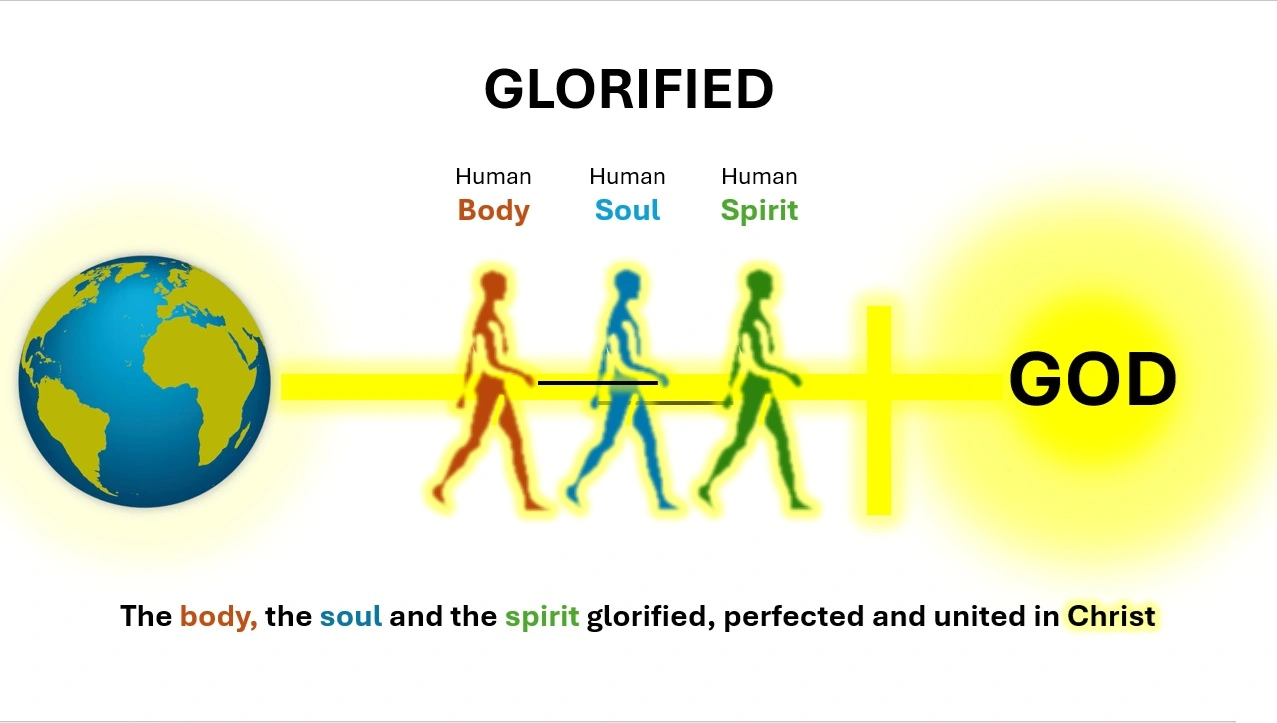
- the soul and
- the body
are finally brought into perfect harmony in Christ. No more tension. No more fragmentation. No more “flesh vs. spirit.” Everything aligned, everything whole.
5. The day is about the bride’s glorification
This is the part most people miss. The wedding day is not about the groom being glorified for He is already glorified. It is about the bride being glorified by the groom’s love. Likewise, glorification is God placing His glory on His people. Not because they earned it. But because He loves them.
A simple way to say it: Glorification is the moment when God dresses His people in the fullness of His beauty, just as a groom delights to present his bride in splendor.
In holy union with Christ, the believer will be perfected. The believer will not be imputed with perfection but will instead be conformed to it. We will need not hide in the crevice of a rock or cover our eyes at the sight of God’s full glory, but instead we will see God face to face (1 Corinthians 13:12). Through Christ’s sharing of His glory, His spirit, never again will we be capable of falling short of the glory of God. Never again will we sin and be separated from Him. What glorious wonders await those whom He glorified.
Scripture is shockingly explicit about this, and when we take it seriously, it reshapes how we understand salvation, creation, and the destiny of humanity. It is nothing short of glorious.
Although, Glorification is often taught as being about restoration (as if God will restore believers to a pre-fallen state), Glorification is instead about transformation. It is about a transformation so profound that the Apostle Paul himself could only describe it as becoming a new creation (2 Corinthians 5:17). This new creation however, is not created ex nihilo. This new creation is created in Christ, meaning it is a participation in His resurrected humanity and holy matrimony between our spirit and His. This distinction is essential for understanding glorification, perfection, and the destiny of redeemed humanity.
Click to open or close: The Perfect Nature & Character of God …
The Perfect Nature & Character of God
God’s natural attributes form a seamless, interwoven whole that expresses the perfection of His divine nature. They are not isolated traits but mutually reinforcing realities that reveal a God who is complete, coherent, and utterly without contradiction.
God’s aseity establishes Him as the uncaused cause—the One whose existence is necessary and self‑sustaining. Because He depends on nothing, His immutability naturally follows: a being who receives nothing from outside Himself cannot be altered by anything outside Himself. This unchanging nature is not static but the fullness of perfect being. His simplicity ensures that His attributes are not separate components but identical with His essence. God does not have love, power, or knowledge as qualities added to Him; He is love, power, and knowledge in one unified act of being.
From this unified essence flows His eternity. A God who is pure, unchanging being cannot be subject to temporal succession. Time does not pass for Him; He possesses all moments in a single, indivisible “now.” This eternal nature harmonizes with His omniscience, for a God outside time knows all temporal events without learning or forgetting. His knowledge is not accumulated; it is intrinsic to His eternal being.
God’s omnipresence and infinity work together to express His boundlessness. Because He is not composed of parts or limited by space, He is wholly present everywhere. His presence is not spread thin but fully Himself in every place. This infinite presence pairs naturally with His omnipotence. A God who is unlimited in being is also unlimited in power. His Omnibenevolence is not partial, His power is not arbitrary but flows from His perfect nature—He cannot contradict Himself, but He can accomplish all that is consistent with His perfect will.
His unity ensures that none of these attributes compete. God’s justice does not battle His mercy; His power does not overshadow His goodness; His knowledge does not diminish His relational presence. Instead, each attribute expresses the same perfect essence from a different angle. His transcendence and immanence illustrate this beautifully: He is above creation in His nature, yet intimately present within it by His sustaining power. He is both infinitely beyond and lovingly near.
Together, these attributes reveal a God who is not merely the greatest being among others but the perfect, necessary, self‑existent foundation of all reality. His attributes do not merely coexist—they interlock, reinforce, and illuminate one another, forming a harmonious whole that displays the fullness of divine perfection.
This is a foundational truth: God alone is perfect in His being. This flows from His aseity—He exists from Himself, depends on nothing, and receives nothing. He is the fullness of being, the One whose essence is identical with existence. Because God is also simple, His attributes are not parts added to Him; He is His attributes in perfect unity. He is:
- perfect power
- perfect knowledge
- perfect goodness
- perfect holiness
- perfect love
Perfection is not something God has; it is what God is.
The guiding principle for how Scripture must be read
The idea that God’s attributes never clash with one another is more than a theological footnote — it’s a guiding principle for how Scripture must be read. When you approach the Bible assuming that God’s love, justice, holiness, mercy, wrath, patience, and sovereignty all coexist in perfect unity, you begin to interpret His actions and His words through the lens of divine harmony rather than human contradiction.
God is not a composite being made of competing parts. He is one, and everything He is flows from that perfect unity. His love is never sentimental in a way that compromises His holiness. His justice is never harsh in a way that diminishes His compassion. His mercy is never indulgent in a way that weakens His righteousness. Every attribute complements the others, forming a coherent and complete picture of who He is.
This matters because Scripture often presents different attributes in different contexts. One passage may emphasize God’s judgment, another His tenderness, another His sovereignty, another His nearness. If we treat these as competing truths, we distort the character of God. But when we understand that every attribute is fully true at all times, we begin to read Scripture with a deeper sense of coherence. God’s actions in history, His dealings with humanity, and His redemptive plan all reflect a nature that is perfectly balanced and utterly consistent.
This harmony also protects us from creating a God in our own image. If we elevate one attribute above the others — love without holiness, justice without mercy, sovereignty without goodness — we end up with a distorted theology. But when we hold all His attributes together, we see a God who is infinitely complex yet perfectly unified, a God whose nature is not fragmented but whole.
In the end, the unity of God’s attributes invites us to trust Him more deeply. Because He is never internally conflicted, His actions toward us are never arbitrary. His love is a holy love. His justice is a loving justice. His mercy is a righteous mercy. Everything He does is the expression of one perfect, infinite, and harmonious God, and that truth becomes a foundation for both understanding Scripture and knowing Him personally.
Through Scripture, we clearly see not only what God is in regard to His glorious nature – His attributes – but who God is, in His glorious Character, in what He chooses to do. This is important because without understanding who God is in character is to understand God as an impersonal machine, without purpose. and to know God’s character without His nature is to know God as capable of thinking and acting with purpose, but without ability. Equally it is important to understand both what and who God is when interpreting Scripture.
See God’s Natural Attribute Article for more …
Entropy: The Potentiality For The Fall of Man
Throughout this work I use “entropy” metaphorically to describe the potential for mutability, change, and moral failure inherent in finite created beings. I am not referring to the scientific concept of thermodynamic entropy.
The potentiality for the fall of man was a consequence of God giving man free will. This is not because God caused it to be so, but instead it is because God cannot create that which is equal to – little lone greater – than Himself ex nihilo (Nehemiah 9:6, 2 Samuel 22:32). Not even the greatest angel – that God created ex nihilo – could truthfully claim equality to God. Only God in His perfection is without entropy. Only God’s promises and teachings are flawless and proven true. Only His ways are just, free from injustice or partiality, and always consistent with His nature. God’s nature is love, mercy, and truth (in mention of but only a few), qualities that are not merely attributes of God but His very essence of perfection. God alone is unchanging perfection. (Numbers 23:19, Mark 10:18, Psalm 18:30, 2 Samuel 22:31, Deuteronomy 32:4, 1 Corinthians 1:9, etc…)
Click to open or close: Why creation ex nihilo cannot be perfect …
God cannot create another God, because:
- a created being would depend on God
- a created being would have a beginning
- a created being would have potentiality and thus, entropy
- a created being would not be identical with its own essence
A being with these characteristics cannot be perfect in the way God is perfect.
Thus, God cannot create an equal or greater being, not because of a limitation in God, but because of the logical impossibility of a “created uncreated being.”
The Only Way for God to Create Something Perfect Is to Create Something “of” Himself
If God creates something from nothing, it is necessarily finite and imperfect. But if God creates something from Himself, it shares His nature. This is why:
- The Son is eternally begotten of the Father (eternal generation).
- The Spirit eternally proceeds (procession).
These are not acts of creation. They are acts of eternal self‑communication within the divine essence. The Son and Spirit are:
- Uncreated
- infinite
- perfect
- immutable
- simple
- eternal
Because they are of God, not made by God. Thus:
God can only produce perfection by communicating His own essence, not by creating something outside Himself.
This is why the Trinity is the only “perfect plurality” in existence.
While Scripture never explicitly states that everything created ex nihilo must necessarily remain capable of falling. Nevertheless, I believe several biblical observations point in this direction.
Perfect Purpose and Perfect Plan
God is Omniscient, He does not guess or anticipate but instead He knows all things past, present and future. He knows all possible realities, both created and uncreated. God knew when, where, how, and why Man would fall to sin. God is a God of purpose, a God of plans and – before creation itself – God had both a purpose and a plan for:
- The creation of Man (created ex nihilo, created very good but not perfect as per God is perfect)
- The fall of Man
- The redemption of Man (through faith in Christ)
- The glorification of Man (the perfection of man through unification and conforming of believers in Christ. Christ becomes our perfection)
Click to open or close: God’s Perfect Intensions
The intent is for all to be glorified
God can sovereignly plan creation and glorification without intending, causing, or determining anyone’s rejection of Him, even though He foreknows that some will freely choose it.
- A parent gives their teenager a car knowing that driving is essential for growth, maturity, and future independence. The parent also knows—based on experience and statistics—that the teen will likely make mistakes.
- The parent’s intent is the teen’s development. The parent’s permission allows the possibility of accidents. The parent’s foreknowledge does not cause the accidents. Neither, by any stretch of the imagination does it imply that the parents intended the accidents.
- Likewise, God’s intent is human glorification. His permission allows free will. His foreknowledge does not cause rejection nor does it mean that God intended that anyone should reject Him.
This preserves God’s goodness, sovereignty, and desire for all to be saved while maintaining genuine human freedom.
How this fits with Predestination
In the event that one should ask how does “Predestining” fit into this analogy I would simply answer that the Biblical context of predestining speaks to predetermining the resulting destiny of an action. For example, if the teenager makes the right decisions when driving, then the teenager is predestined to receive reward. Conversely, if the teenager makes a wrong decision, then they are predestined to receive some form of penalty. Again, the parents could be said to have given potential for the teenager to make a wrong choice, but their intent would be that the child make the right decision and receive the predestined reward. Regardless, it is teenagers choice that determines if they are to receive the reward or the penalty that the parents predestined.
The parent‑and‑teenager analogy illustrates a key distinction:
- Foreknowledge (the parent knows accidents are likely)
- Intention (the parent does not want or plan the accidents)
- Causation (the parent does not cause the accidents)
- Permission (the parent allows the teen to drive because driving is part of growing into maturity)
- Predestination (Right choices and actions are destined to reward, Wrong choices and actions are destined to penalty)
This maps closely to the theological categories of free will, foreknowledge, and divine permission.
How this fits within Glorification
1. God’s intent: universal repentance : Scripture repeatedly affirms that God’s desire is that all should come to repentance and share in glorification. This supports the claim that rejection is not God’s intention.
2. God’s plan: creation → fall → redemption → glorification. In this framework, the fall is not the goal but the context in which God’s redemptive glory is revealed. This means:
- The fall is foreknown
- The fall is incorporated into God’s plan
- The fall is not caused by God
- Human freedom remains real
3. Human free will: the capacity to do otherwise. If God genuinely gives humans free will, then humans can choose something other than what God desires. This is exactly what the analogy captures: The parent’s will is for safety and maturity, but the teen’s free choices can diverge from that will.
This preserves God’s goodness, sovereignty, and desire for all to be saved while maintaining genuine human freedom. The real tension isn’t between foreknowledge and free will—those can coexist. The deeper tension is between God’s will of desire (what He wants) and God’s will of permission (what He allows for the sake of a greater good).
With all this said however, it is not to say that what God creates ex nihilo is flawed or that it is not perfect in accordance with His purposes and plans.
Before the beginning of time itself, God had elected (chosen) Himself to become flesh and to pay the price that His justice demanded for the sins of the human inhabitants of this world. God’s plan was not merely to restore mankind to a pre-fallen state so that the same potential consequence could be repeated. Instead, God’s plan was to use the fall as the means to create a new creation, to transform that which was created ex nihilo and at its best was very good, into that which will be perfect. A transforming power that is not merely an imputation or putative state of perfection but instead an event of glorification in conforming the bride (the Church) to the image and inseparable love of Christ – the Bridegroom (2 Corinthians 5:17).
This is the mystery Paul describes in Ephesians 5:31–32: the future union of two free, though unequal, partners and where the two become one in a covenant of love (Romans 8:9). This process of transformation should not be understood as a blending of the divine and the human, nor as the loss of distinction between them. Even the phrase “one flesh” does not imply that either person loses his or her individual identity. A man does not become a woman, nor a woman a man when untied as one in holy matrimony. This transformation does not mean that we will become Christ, that we will become God, gods or goddesses. There is only one God and there will never be another.
While we know that God has created all that has been created, we know not the technical details of how He created, Job 38:2-41. Likewise, neither may we comprehend – certainly I do not – the technical details of how God will transform believers into a new creation, but God says that He will. Scripture clearly says that which was created very good, that which fell to sin, that which was separated from God, that which was redeemed by Christ, that which is being perfected will become a new creation. A new creation inseparable from God, perfected and glorified in Christ. This is not a plan B instituted after the fall of man, but instead this is the plan and always has been the plan that God instituted before creation itself. This is the plan, this the why it was necessary, that for a little while, we are created a little lower than the angels. So that there will come a time when we as believers will become greater than the angels. Where we will have a perfection that will allow us to draw closer to our perfect God than would otherwise be possible – even for the angels. In our glorification, we will experience the glory of God beyond anything even the angels could begin to imagine.
What is Perfection?
The English word “perfection” found in some translations of the New Testament (see Ephesians 4:13 ESV vs Ephesians 4:13 KJV) is translated from the Greek word “telios”, identified in the Strong’s Concordance as [G5046]. The Strong’s concordance defines the word as: complete (in various applications of labor growth mental and moral character etc.); neuter (as noun with [G3588]) completeness: – of full age man perfect.
Thayer’s Definition includes: brought to its end, finished. Wanting nothing necessary to completeness (Lacking nothing) . Perfect, that which is perfect, consummate human integrity and virtue of men, full grown, adult, of full age, mature.
When God saw everything that He had made, He said it was “very good” (Genesis 1:31). God did not say it was perfect and this is because it was created ex nihilo and could not be perfect. If Adam and Eve were perfect then they would have wanted nothing necessary to completeness – perfection. However, when Eve saw the tree was good for food, and that it was a delight to the eyes, and that the tree was desired to make one wise, she took its fruit and ate (Genesis 3:6 ESV). Eve was therefore wanting something necessary to completeness, to perfection. Now it was not a sin for Eve to desire to be like God, else we would have to say Eve sinned even before eating the forbidden fruit. Furthermore, if desiring to be like God is a sin then every Christian that desires to be like Christ must too be guilty of sin. Disobedience in eating of the forbidden fruit that God had commanded Adam and Eve not eat of, was the sin. A wrongful act that a perfect being would not engage in, because a perfect being would be unable to do anything unrighteous.
In its classical sense, the English word “perfect” also means “complete” or “lacking nothing.” We can understand perfection conceptually, but we may not be able to measure it fully in practice. It is easier to recognize imperfection by imagining something better; but if we cannot imagine an improvement, how can we know whether the object is truly perfect or whether our imagination is simply limited? In nearly every complex case, only God has the necessary middle knowledge—the full range of “what ifs”—to declare something perfect with certainty.
Perfection of the Saints in Glorification
Both the Old and New Testaments teach that God is the God of glory, that Jesus Christ is the Lord of glory, and that God will share His glory with His children through glorification. Salvation, already begun in the present, will reach its fulfillment in eschatological glory.
One important New Testament theme is perfection, though it is often neglected. Several related Greek terms—teleiotes, teleiosis, teleo, and teleios—help frame this idea. In brief, the motif of perfection may be outlined as follows:
- God has an intended goal (telos) for His people.
- That goal includes the perfection (teleios) of the individual believer.
- This requires a perfecter (teleiotes) who must Himself be perfected and so become perfect.
- In this way, He can perfect (teleo) those who come to God and bring them to perfection (teleios).
In this life, “perfection” refers to spiritual, moral, and doctrinal maturity. In the life to come, it also refers to the completion of salvation. In this way, God’s intended purpose (telos) reaches its fulfillment.
Useful material on perfection is relatively scarce, largely because debate over the extent of sanctification in this life often overshadows the subject. As a result, perfection as a dimension of salvation—and as an eschatological theme—is frequently neglected. Yet the theme presents God’s goal (telos) for His people: through the Perfecter, believers grow into spiritual, moral, and doctrinal maturity in this life and reach the completion of salvation in the life to come.
The doctrine of perfection may be summarized as follows:
- Having been perfected through His own experience (see Hebrews), Christ is both the Perfecter of believers and their perfection. He is the leader (arxegos) of believers because He first attained perfection (Hebrews 2:10). He did so by entering fully into the conditions of human existence (Hebrews 2:12–18), learning obedience through suffering (Hebrews 5:7–10), and finally enduring death itself. Raised from the dead, He stands as the perfect fulfillment of all that the Old Testament promised: the true and perfect Moses, Aaron, priest, temple, sacrifice for sin, and Savior of all who come to God through Him.
- In this life, Christ gives believers His perfection while also calling them to maturity. His bestowed perfection is equivalent to salvation (soteria; Hebrews 2:10; 5:9), so in this sense Christ Himself is the perfection of believers. As the perfect One present in both the believer and the Church, He leads His people toward glory by calling them to faith and growth in Christian maturity. Yet this present growth points forward to a future, completed perfection. For that reason, passages such as Philippians 3:12 and Hebrews 10:14 anticipate the character of final glorification.
- In the ages to come, maturity gives way to full perfection. This belongs to the structure of glorification, and in that sense perfection and glorification coincide. John 17:23 and Hebrews 2:10 both point to this final completion, in which believers are brought into perfected unity and glory through Christ.
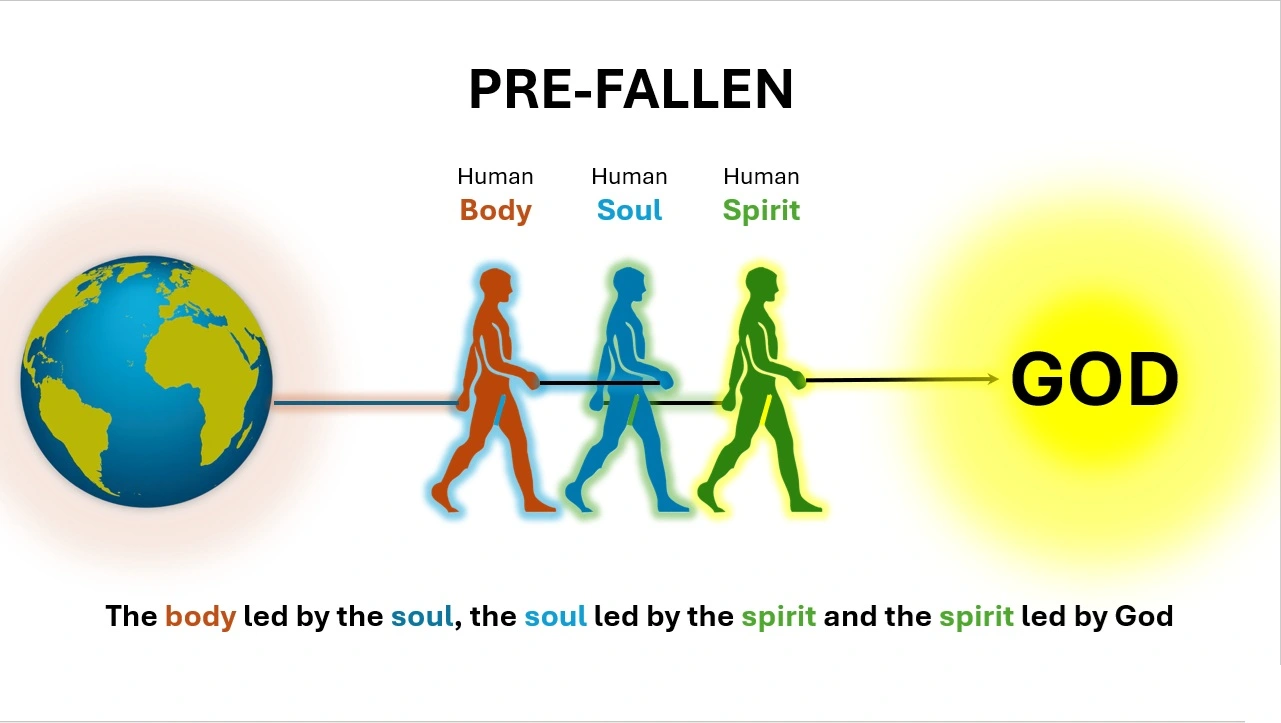
The Pre-fallen State
The body led by the soul, the soul led by the spirit and the spirit led by God
Creation Was Never the Final Goal—It Was the Beginning of a Process
Scripture never presents the original creation as the end of God’s plan. Instead, it presents creation as the starting point of a divine process leading to glorification. Paul writes: “The creation itself will be set free… into the freedom of the glory of the children of God.” — Romans 8:21. Creation was designed to move toward something—the glory of redeemed humanity. This means:
- Eden was not the final state
- Adam was not the final man
- The first creation was not the final creation
Creation was the arena in which God would bring about the perfection of His people in Christ. This aligns with the doctrine of teleology—God creates with an end in mind.
God Created Man “in His Image,” Not “of His Essence”
Genesis 1:26: “Let us make man in our image, after our likeness”. Man is created in God’s image, not of God’s essence. This distinction is crucial:
- God is uncreated, infinite, perfect
- Man is created, finite, and mutable
This aligns with the doctrine of aseity: only God is self‑existent. Thus, Adam was:
- good
- upright
- holy
but Adam was not perfect in the divine sense. Adam reflected God, but he did not share God’s essence. This means Adam had:
- free will
- potentiality
- mutability
And where there is potentiality, there is the possibility of entropy—moral or spiritual decline.
Free Will Introduces Potentiality, and Potentiality Leads to Entropy
A being with free will must have the capacity to choose. This means such a being has potentiality. Potentiality is the opposite of God’s nature, for God is pure act (actus purus). Adam’s potentiality meant:
- he could choose good
- he could choose evil
- he could grow
- he could fall
Thus, the fall was not an accident—it was a metaphysical possibility inherent in creatureliness. This is why Paul writes:
“In Adam all die.” — 1 Corinthians 15:22
Adam’s fall was not merely moral; it was the outworking of the fact that created free beings are not perfect.
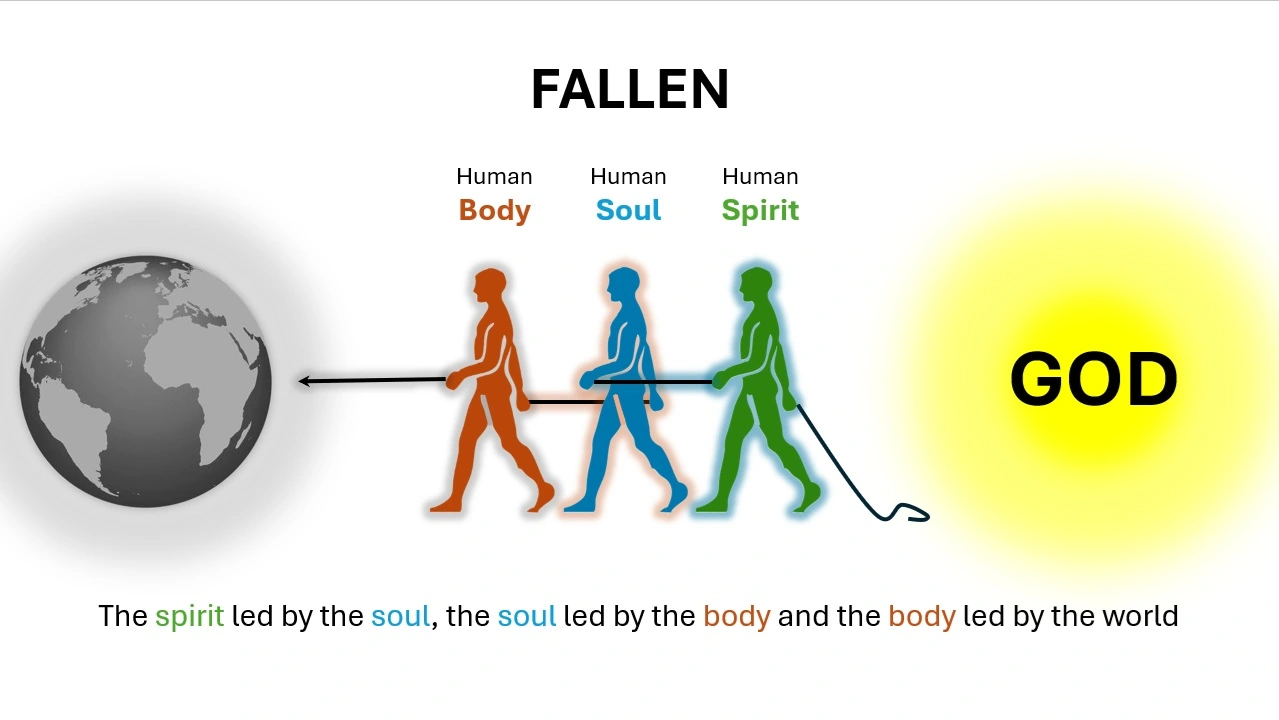
The Fallen State
The spirit led by the soul, the soul led by the body and the body led by the world
The Fall Was Foreknown and Incorporated Into God’s Redemptive Plan
Scripture teaches that Christ’s redemptive work was planned before creation:
- “The Lamb slain from the foundation of the world.” — Revelation 13:8
- “He chose us in Him before the foundation of the world.” — Ephesians 1:4
This means:
- God knew Adam would fall
- God planned redemption before creation
- Creation was designed with the incarnation in view
The fall did not derail God’s plan—it activated it.
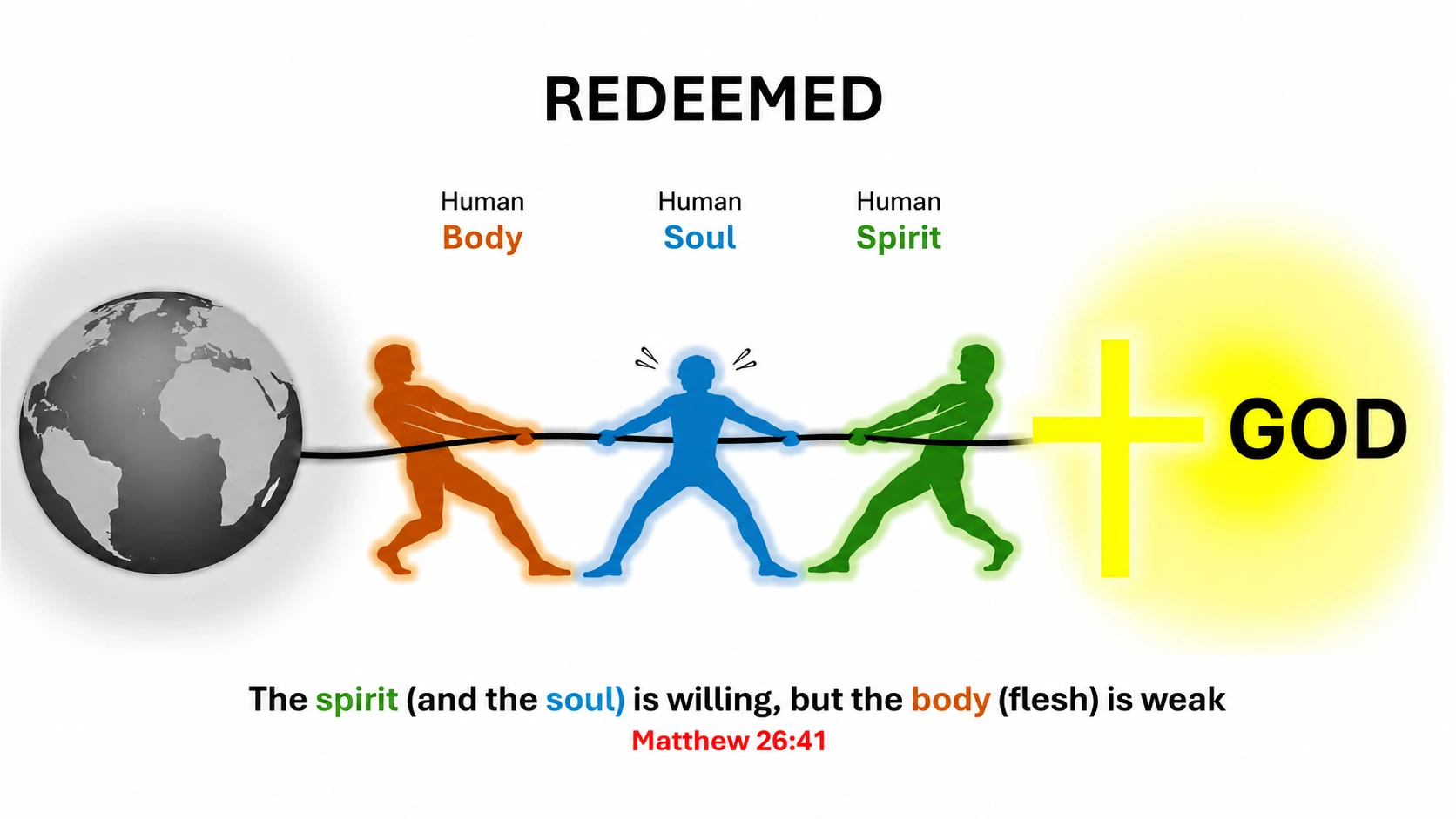
The Redeemed State
The body led by the soul, the soul led by the spirit and the spirit led by Holy Spirit
God’s Plan Was to Become Incarnate and Bear Man’s Punishment
The incarnation was not Plan B. It was the centerpiece of God’s eternal purpose.
- “The Word became flesh.” — John 1:14
- “He bore our sins in His body on the tree.” — 1 Peter 2:24
Christ became:
- fully human
- in the likeness of sinful flesh (Romans 8:3)
- yet without sin
This reveals the harmony of God’s justice and love:
- Justice: sin must be punished
- Love: God Himself bears the punishment
The cross is where God’s attributes meet in perfect unity.
Believers Are Imputed With Christ’s Righteousness in This Life
Justification is imputed righteousness: “He made Him who knew no sin to be sin for us, so that in Him we might become the righteousness of God.” — 2 Corinthians 5:21
This righteousness is:
- legal,
- forensic,
- declarative,
- complete
But it is not yet transformative perfection. Believers still sin, still struggle, still groan (Romans 8:23).
Thus, imputation is the beginning, not the end.
The Glorified State of the Saints
The body, the soul and the spirit – not just led – but glorified, perfected and united in Christ
Glorification Is the Final Step—Perfection “In Christ”
At the resurrection or rapture, believers are glorified: “Those He justified, He also glorified.” — Romans 8:30
Glorification includes:
- removal of the sin nature
- transformation of the body (1 Corinthians 15:52–54)
- perfection of the will (1 John 3:9)
- inability to fall (Jude 24)
- eternal union with Christ (Romans 8:39)
This is not merely imputed righteousness. It is imparted, shared, participatory righteousness.
Believers become:
- incorruptible
- immortal
- sinless
- perfected
Not by nature, but by union with Christ.
Glorification Is Participation in Christ’s Life—Not Creation of a Perfect Creature
God cannot create perfection from nothing. But He can communicate perfection from Himself. However, a being created ex nihilo could never be capable of receiving God’s perfection – His full glory. In order for this to happen God had to create a being capable of natural death so that Christ could become the image of that being and in turn redeemed beings could become in the image of Christ. With this understanding we better grasp why our God – a God of purpose – purposed to do as He has done. This is why glorification is described as: “Christ in you, the hope of glory.” — Colossians 1:27
Believers are:
- “partakers of the divine nature” (2 Peter 1:4)
- “conformed to the image of His Son” (Romans 8:29)
- “like Him” (1 John 3:2)
This is not becoming God. It is sharing in Christ’s resurrected humanity.
Glorified Saints See God in a Way Angels Cannot
Jesus said: “Their angels always behold the face of My Father.” — Matthew 18:10
Angels see God—but not in the same way glorified believers will.
Believers will see:
- “God face to face.” — 1 Corinthians 13:12
- “We shall see Him as He is.” — 1 John 3:2
This is the beatific vision, something angels do not experience in the same mode because:
- angels are not united to Christ
- angels are not redeemed
- angels are not adopted as sons
- angels do not share Christ’s resurrected life
Believers will behold God in Christ, sharing the Son’s own relationship with the Father.
Summary: Creation Was the Beginning of God’s Plan to Perfect Humanity in Christ
Why Glorification Produces True, Eternal Perfection
- God cannot create perfection from nothing.
- But God can perfect a creature by uniting it to Himself in Christ.
- Glorification is not creation; it is participation.
- The believer’s perfection is derivative, dependent, and eternally upheld.
- This perfection removes all potentiality for sin.
- Therefore, glorified believers can never fall, sin, or be separated from God.
This is the only metaphysically coherent way for a creature to become perfect.
Putting it all together:
- God created man in His image, not His essence
- Free will introduced potentiality
- Potentiality made the fall possible if not certain
- The fall activated God’s eternal plan
- God became incarnate to bear man’s punishment
- Believers are justified by imputation
- Believers are glorified by participation
- Glorification perfects the believer in union with Christ
- This perfection is eternal, sinless
- and unbreakable
- Glorified believers see God in a way angels cannot
Thus: Creation was never the end. Glorification of the Saints in Christ was always the goal.
Reflection
Throughout this introductory section we have proposed that the Bible is not merely a collection of historical events, moral lessons, or independent doctrines. Rather, it records the progressive unfolding of God’s eternal purpose. From Genesis to Revelation, Scripture reveals one continuous story centered upon Jesus Christ and culminating in the glorification of redeemed humanity.
The Old and New Testaments consistently present God as the God of Glory, Jesus Christ as the Lord of Glory, and believers as those who are called to share in His glory. Salvation therefore extends beyond forgiveness and justification. It is the gracious work by which God prepares His people for the glory He has purposed for them in His Son.
This introduces one of the great but often overlooked themes of Scripture: perfection.
The New Testament repeatedly employs words derived from the Greek root telos, meaning end, goal, purpose, or completion. From this family of words we learn several foundational truths:
- God has established an eternal purpose (telos) for His people.
- That purpose culminates in their perfection (teleios).
- Such perfection requires a Perfecter (teleiotes) who Himself must complete the work entrusted to Him.
- Having been perfected through His earthly mission, Jesus Christ now perfects those who come unto God through Him.
Perfection therefore belongs to both the present and the future.
Today believers grow toward spiritual, moral, and doctrinal maturity.
Tomorrow they shall be perfected in glory.
This distinction will guide the remainder of this work as we follow God’s purpose from creation to its glorious consummation.
Key Takeaways
- Scripture tells one continuous story and reveals one unified purpose from Genesis to Revelation.
- Creation, the fall, redemption, and glorification are not isolated doctrines but successive stages in God’s eternal purpose.
- God’s ultimate purpose centers upon and is revealed in Jesus Christ.
- Salvation prepares believers for glorification.
- God’s eternal goal (telos) is the perfection of His redeemed people.
- Christ is the believers savior and both the Perfecter and the believer’s perfection.
Looking Ahead
If God’s purpose unfolds progressively, we must begin where Scripture begins—with creation itself.