
Romans 9
Estimated time to read:
Read this article to me
Suggested prerequisite reading:
Supporting Articles:
Paul’s Pastoral Response to a Crisis of Faith
Calvinism and Reformed Tradition often point to Romans 9 as proof text for their doctrines of Election & Predestination. However, Romans 9 is not an abstract philosophical treatise on election and predestination; it is Paul’s deeply pastoral response to a real crisis of faith among newly converted Jewish believers in Rome. These men and women had embraced Christ as Messiah, yet they were now confronted with a painful and disorienting reality: the nation of Israel—God’s chosen people—had largely rejected Christ. What did this mean for Israel, for their families, friends, teachers, and religious leaders who were not only refusing the gospel but actively opposing it. To appreciate and understand Romans 9 one must read it through the lens of Paul’s audience.
Click to open or close: To understand Romans 9, we must see it through the lens of Paul’s audience.
The Crisis: “If Israel Has Rejected Christ, What Does That Mean for God’s Promises?”
For first‑century Jewish Christians, the rejection of Christ by Israel raised agonizing questions:
- Had God abandoned Israel?
- Had His promises failed?
- Was the covenant with Abraham now void?
- Were their families and kinsmen—those who rejected Christ—now outside God’s plan?
- If Gentiles were entering the kingdom while Israel resisted it, had God replaced His people?
These were not academic questions. They were personal, emotional, and destabilizing. These believers had grown up hearing that Israel was:
- the people God had chosen,
- the nation set apart from all others,
- the recipients of the covenants,
- the guardians of the Law,
- the heirs of the promises,
- and the lineage through whom the Messiah would come.
If all of that was true, then should not salvation be the birthright of every Jew?
So when many Jews rejected Christ and persecuted those who followed Him, Jewish Christians were left wondering whether the problem lay with:
- Israel,
- the gospel,
- Paul,
- or even God Himself.
The Accusation: “Has God Failed?”
Many were second‑guessing everything they had believed. Some were asking:
- “If Israel is rejecting the Messiah, does that mean God’s promises were false?”
- “Has God forsaken His covenant people?”
- “Is Paul misleading us?”
- “Are the Gentiles now replacing Israel?”
This is the emotional and theological storm Paul steps into in Romans 9. Paul’s Jewish readers were not merely wrestling with doctrine; they were wrestling with the fate of their families, communities, and heritage. Their priests, Pharisees, Sadducees, rabbis, and lifelong friends were rejecting Christ. Were these people now lost, blind, and cut off? Or was Paul the one who had misunderstood God’s plan?
Paul’s Purpose in Romans 9
Romans 9 is Paul’s attempt to answer these questions with clarity, compassion, and theological precision. His goal is to show that:
- God has not failed. His promises to Israel remain intact.
- Israel’s unbelief does not invalidate God’s word.
- The rejection of Christ by many Jews does not mean God has abandoned His people.
- The inclusion of Gentiles does not contradict the Old Testament—it fulfills it.
Paul is not redefining Israel. He is explaining how God’s promises to Israel are being fulfilled, even in the midst of widespread Jewish unbelief.
Why This Matters for Interpreting Romans 9
Romans 9 is often read as if Paul were writing a philosophical essay on individual predestination. But that is not the crisis he is addressing. His concern is corporate, historical, and covenantal:
- What is happening to Israel?
- How does Israel’s unbelief fit into God’s plan?
- Has God’s word failed?
- What does this mean for Jewish Christians whose families reject Christ?
When we read Romans 9 through the lens of Paul’s audience—Jewish believers grieving over the unbelief of their own people—the chapter becomes not a cold doctrinal formula but a passionate defense of God’s faithfulness.
Summary
Romans 9 is Paul’s pastoral response to Jewish Christians who feared that Israel’s rejection of Christ meant:
- God’s promises had failed,
- Israel had been abandoned,
- the covenants were void,
- and their families were lost.
Paul writes to assure them that God has not failed, His promises stand, and Israel’s story is far from over.
It is important to understand the back story
When we read Romans it is important to understand that the Roman community Paul was addressing was at least familiar with the Torah, which he endeavored to connect some Old Testament passages – often by paraphrasing and by leaving out much of the lengthy back story – with the Gospel message to show that neither of these are in conflict with God’s promises to Israel. For us as the modern reader of the book of Romans, knowing and understanding these back stories is critical to maintaining proper context of Paul’s message. Likewise, much of the language, the terms, and phrases that Paul uses are not fully explained / defined in Romans. Further context, explanation and definitions of these terms can be found in his earlier writings like Galatians and 1 Corinthians etc. Therefore, it is advisable to read these letters and or epistles prior to reading Romans or to make use of a good concordance that will point to critical references in other books, as well as a good dictionary of Old Testament Hebrew and New Testament Greek.
As always, when it comes to interpretation, Scripture must be allowed to interpret Scripture over all other methods. Interpretation and Doctrine(s) must be supported contextually and consistently throughout all Scripture, in a progressive manner. God is not a God of contradiction and so neither does His word contain contradictions or paradoxes. Therefore, any interpretation that contradicts Scripture even in part or that contradicts the nature and character of God, must be considered incomplete or completely wrong 1 Timothy 6:20.
Romans 9:6-8
Paul asserts that “the word of God has not failed,” referencing the promises given to Israel in the Torah. While Jews were familiar with these promises, Gentiles might not be; however, Paul clarifies that God’s promises are irrevocable and still stand. He distinguishes ethnic Israel from Israel of faith, explaining that the promise was conditional upon faith and obedience, as shown in Exodus 19:3-6. Not all physical descendants are considered true children of God—only those who follow in Abraham’s faith inherit the promise, illustrated by Isaac’s distinction among Abraham’s children (Genesis 21:12). Ultimately, believers are adopted as God’s children, reinforcing that rejection of the Gospel by some does not undermine its power or validity; it is faith, not lineage, that secures the promise (Romans 8:14, Galatians 3:26).
Paradigm between Israel of Flesh & Faith and The Invisible Church and the Visible Church
Paul’s distinction in Romans 9:6–8 also provides a helpful analogy for understanding the difference between the visible and invisible Church. Just as not every physical descendant of Abraham belonged to the true covenant people of God, so not everyone who outwardly belongs to the visible Church necessarily belongs to Christ. Paul writes, “For not all who are descended from Israel belong to Israel” (Romans 9:6, ESV). Within national Israel there existed two groups: those who merely belonged according to the flesh, and those who belonged according to the promise through faith. Outward membership in the covenant nation did not, by itself, guarantee a right relationship with God.
The same principle may be observed within the Church today. The visible Church consists of all who profess faith in Christ and outwardly identify with the Christian community. Within that visible body are both sincere believers and those whose profession is merely external. The invisible Church, however, consists only of those who have truly been regenerated by the Holy Spirit and united to Christ through genuine faith. God alone perfectly knows those who are His (2 Timothy 2:19).
This distinction helps explain why Scripture repeatedly warns those within the covenant community to examine themselves (2 Corinthians 13:5), why Jesus spoke of wheat growing together with tares until the harvest (Matthew 13:24–30), and why He declared that not everyone who says, “Lord, Lord,” will enter the kingdom of heaven (Matthew 7:21–23). Membership among God’s visible people has never, by itself, guaranteed salvation. As was true within Israel, so it remains within the visible Church: there are those who belong outwardly according to the flesh and those who belong inwardly according to faith. It is the latter—the children of the promise—who are truly counted as the people of God.
Romans 9:9-13
Paul, aware that his initial argument about Abraham’s children may not be persuasive since only Isaac was Sarah’s son, shifts to Jacob and Esau—twins of Isaac and Rebecca. This passage is frequently cited in Reformed and Calvinist discussions on election and predestination, but it is vital to clarify its terminology for accurate understanding. According to Strong’s Concordance ([G1586] “eklogē”), “election” means “chosen,” prompting the question: chosen for what? Paul explains it as being chosen so God’s purpose continues through Abraham, Isaac, and Jacob—not due to merit or works, but through God’s call, fulfilled in Christ.
Paul cites Genesis 25:23—”The older shall serve the younger“—but Esau never personally served Jacob. The full verse refers to nations (corporate election), not individuals: Jacob represents Israel, Esau represents Edom. God’s choice was made before their births, without regard to personal merit. Paul’s use of this passage shows that God elected corporate Israel over corporate Edom, rather than predestining individual salvation.
Paul’s Old Testament reference Malachi 1:2-3 ““I have loved you,” says the LORD. But you say, “How have you loved us?” “Is not Esau Jacob’s brother?” declares the LORD. “Yet I have loved Jacob [3] but Esau I have hated. I have laid waste his hill country and left his heritage to jackals of the desert.” should be interpreted in context, where “love” and “hate” refer to preference and rejection rather than emotion. For instance, Luke 14:26 “If anyone comes to me and does not hate his own father and mother and wife and children and brothers and sisters, yes, and even his own life, he cannot be my disciple “ suggests Jesus meant followers must value Him above all else, making other relationships seem less significant. The Greek word for “hate” (miseō) can mean “to love less,” while in Hebrew it implies separation or rejection, focusing on actions over feelings. Biblically, God’s “hate” of Esau signifies choosing Jacob for his covenant, not a lack of care—Esau was still blessed with wealth and land.
The biblical idea is that God’s love and hate are about acceptance and rejection, not emotional response. If we are to say that God’s Character is one of both Love and Hate, then what we are to really say is that God’s Love is the choice of acceptance and rejection.
Romans 9:14-16
As stated by F. Leroy Forlines: “When we read in Romans 9:15 that God will have mercy and compassion on whomever he wills, it behooves us to ask on whom does God Will, to show mercy and compassion? When God chooses the one who believes in Jesus Christ as his Lord and Savior to show his mercy and salvation, He is choosing whom He Wills. When salvation is offered on the condition of faith in Christ, that no way weakens the words ‘I will have mercy on whom I will have mercy’. God’s sovereignty is fully in control in this view”
Romans 9:17-19: Hardening of the Pharaoh’s Heart
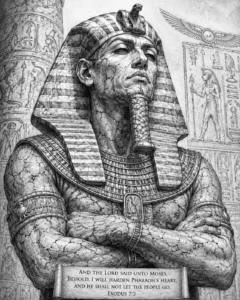
Romans 9:17-19 is often used as proof text for Calvinist doctrine that teach God had Elected and Predestined certain individuals to serve as objects of His wrath. This pre-selection, consistent with deterministic theism (meaning selected and designed by divine decree), ensures that those elected unto salvation would better appreciate His glory, power, and mercy.’ However, neither this passage nor the Old Testament passage that Paul paraphrased implies that God unilaterally hardens hearts against Him or to keep one from obtaining salvation.
1. Hardening in Scripture Is Judicial, Not Arbitrary
The biblical pattern of divine hardening is always judicial, never arbitrary. God hardens those who have already hardened themselves. Pharaoh repeatedly hardened his own heart before God confirmed him in that state (Exodus 7:13; 8:15, 32; 9:34).
Paul’s Jewish audience would have understood this. They knew that God’s hardening of Israel was not an act of arbitrary predestination but a judgment on persistent unbelief (Romans 10:21; 11:7–10).
Thus, Romans 9:17–19 cannot be used to argue that God predestines individuals to damnation before they exist or apart from their moral choices.
2. The Garden of Eden Demonstrates Moral Agency, Not Determinism
When God placed the Tree of the Knowledge of Good and Evil in the garden, He did not:
- tempt Adam and Eve,
- coerce them,
- deceive them,
- force them,
- or necessitate their disobedience.
Instead, God:
- gave a clear command,
- provided a clear warning,
- and endowed humanity with genuine moral agency.
If God had predetermined their sin, then Eve’s accusation—“The serpent deceived me” (Genesis 3:13)—would make no sense. She would have accused God, not the serpent. This alone undermines any theological system that claims God is the ultimate cause of human sin.
3. Scripture is Clear; Deterministic Hardening by God is Impossible
James 1:13–15 states: “God cannot be tempted by evil, nor does He tempt anyone.” This passage directly contradicts the idea that God:
- hardens people into unbelief,
- blinds them against the gospel,
- or compels them toward sin and evil.
To claim that God irresistibly hardens individuals into unbelief is to attribute to God what Scripture attributes to:
- Satan (John 8:44),
- the human heart (Jer. 17:9),
- and the deceitfulness of sin (Heb. 3:13).
To confuse God’s righteous purposes with Satan’s destructive purposes is to collapse the moral distinction Scripture carefully maintains.
4. The Exodus Backstory of the Pharoah’s Hardened Heart
When we look to the backstory of Exodus, we see that it was the Pharaoh himself who first hardened his heart and rejected God. Exodus 5:2 ESV: “But Pharaoh said, “Who is the LORD, that I should obey his voice and let Israel go? I do not know the LORD, and moreover, I will not let Israel go“. One should be cautious of the questions one asks, if there is even a remote chance that they may not like the answer and the Pharaoh was not going to like God’s answer Exodus 7:5. However, while God may allow and use hardened hearts, it does not mean that God wishes, desires or necessitates anyone’s heart, including that of the Pharoah’s heart to be hardened, else that would be contrary to God’s very nature.
5. Clarifying the Meanings of the Original Hebrew and Greek Words.
In the Old Testament, the word “harden” is an English translation of the Hebrew word “chazaq” and according to the Strong’s Concordance “chazaq” can be translated as [H7185] in Exodus 4:21 and or [H2388] in Exodus 7:13:
- To make strong, be strong, grow strong
- To make or to be resolute
- To make or to be sore
- To make or to be grievous
- To harden,
- To prevail over
- To produce courage or to be courageous
- To repair and sustain.
Interestingly, it is only in the Book of Exodus that the Hebrew word “chazaq” is translated as “harden” or “hardened” in the Old Testament.
6. God’s Foreknowledge of the Pharaoh’s Response.
God foreknew that the stretching out of His hand against the Pharoah would only further enrage him and make him only stronger, more resolute, more grievous and more hardened. However, this does not mean that God forced the Pharoah’s heart to be hardened. God no more forced the Pharoah’s heart to be hardened than His favoring of Able’s offering forced Cain to murder his brother. The Pharaoh’s hardened heart, from beginning to end, was his own doing—without coercion or culpability on God’s part—and was made only stronger/harder in unrighteousness by his own anger and resentment of God’s answer to His question. We might call the Pharoah a lost cause because even when he finally realized the truth of God, he rejected the opportunity to humble himself and submit to Him.
7. Why God Take Credit for Hardening the Pharoah’s Heart.
Well because God did harden the Pharoah’s heart BUT not in the context of the conventional sense that it is often taught. In other words, God did not arbitrarily create some to have a hardened heart, nor did He reach into a person’s unhardened heart and make it hard. Instead, it was the righteous truth of God and His word that provoked humbleness in the receptive heart and hardening of the unreceptive heart. Take a look at Romans 11:14 in which Paul says, “in the hope that I may provoke my own people to jealousy and save some of them.“
This verse reflects the Apostle Paul’s desire to reach his fellow Jews with the message of Christ, hoping that their jealousy over the blessings received by the Gentiles would lead them to embrace the faith. It emphasizes the strategic approach to evangelism within God’s redemptive plan, to provoke envy among those who do not share the same humble “heart-felt” values and all for the purpose of producing a change of heart in some. Paul’s statement “save some of them” does not indicate that he or God desires only some to be saved, as if they are selective. Rather, it indicates that some hearts are so hardened that they are indifferent and unreceptive to God’s leading, and may even develop a sense of grievous bitterness.
8. Drawing Contextual Support From Scripture
a) Consider the words of Jesus in John 8:45-47: “But because I tell the truth, you do not believe me. [46] Which one of you convicts me of sin? If I tell the truth, why do you not believe me? [47] Whoever is of God hears the words of God. The reason why you do not hear them is that you are not of God“. This verse is not implying that the Jews did not believe Jesus because He told them the truth. Instead, it says the reason they did not hear and believe Him when He told them the truth was that they were not of God. Instead, they were of the Devil who is a liar and deceiver.
Jesus was not taking credit as the reason for their unbelief, but rather, “for the fact that” they were of Satan, they were hard of understanding, of hearing and as we might say hard of heart. Too hard of heart to hear or to believe the truth. Neither does Jesus take credit for initiating their hardened unreceptive hearts as that hardening was self-inflicted and grew only stronger, more resolute and was provoked to grievous anger when Jesus spoke the truth to them. So much anger that they picked up stones to throw at Jesus, John 8:59.
b) We find this same context in John 12:39-40, where John – paraphrasing from Isaiah 6:8-10 -says “he has blinded their eyes and hardened their heart”. This means that John’s use of the word “hardened” takes its context from Isaiah 6:8-10. Take careful note that Isaiah 6:10 does not use the word “hardened: but instead uses the word “DULL”.
The English word “dull” is translated from the Hebrew word “shaman”, meaning to become fat, grow fat and show fat. They became fat – filled, fattened and dulled in slumber – from Isaiah’s continued warnings that they were not seeing with their eyes and understanding with their heart. Isaiah’s message became like an irritant grievous noise that they did not want to hear and thus tuned it out and ignored it. God knew what would happen but God told Isaiah to keep on warning them despite the fact that they would tire, that they would not understand and that they would grow dull from hearing it.
Now lets ask ourselves who is the “He” – that John was speaking of in John 12:39-40 – whom “has blinded their eyes and hardened their heart, , lest they see with their eyes, and understand with their heart, and turn”? It would be more than difficult to reconcile that God was the one blinding and hardening the hearts of the people rather then the “ruler of this world” – Satan – when God clearly says “and I would heal them”.
Again, context is everything and the first six chapters of Isaiah provides a contextual story of Isaiah repeatedly saying “woe is thee” to the people of Israel, Isaiah 3:9 “For the look on their faces bears witness against them; they proclaim their sin like Sodom; they do not hide it. Woe to them! For they have brought evil on themselves. Now allow me to repeat the last six word of that verse that says “they” – being the nation of Israel – “brought evil” – being Satan – “on themselves”. And that would be further contextualized in 1 John 5:18-20, where we clearly see that man is the one who hardens his heart in rejection of God and His word.
When a person rejects God in hardness of heart, he brings evil upon himself and becomes deaf and blind to the word of God and this is exactly what John was referring to when he paraphrased Isaiah who said “make the heart of this people dull …”.
c) If understood in proper context, the same aforementioned concepts apply to 2 Thessalonians 2:11 ESV: “Therefore God sends them a strong delusion, so that they may believe what is false”. Paul was speaking 2 Thessalonians 2:1 where he said there were already many false teachers, who were proclaiming a different gospel and that the second coming of Jesus had already taken place. This would have undoubtedly shaken any Christian who might fall prey to such deception and believe they had been left behind (2 Thessalonians 2:2-4.
The “man of lawlessness” that Paul is speaking of is the Antichrist in which he asks the rhetorical question 2 Thessalonians 2:5 ESV: “Do you not remember that when I was still with you I told you these things?“, and furthers to explain 2 Thessalonians 2:6-8 ESV: “And you know what is restraining him now so that he may be revealed in his time. [7] For the mystery of lawlessness is already at work. Only he who now restrains it will do so until he is out of the way. [8] And then the lawless one will be revealed, whom the Lord Jesus will kill with the breath of his mouth and bring to nothing by the appearance of his coming”.
The “what is restraining him” is none other than God. However, the mystery (not yet revealed) of lawlessness is already at work in deceiving people, and Paul clearly explains that 2 Thessalonians 2:9-10 ESV: “ The coming of the lawless one is by the activity of Satan with all power and false signs and wonders, [10] and with all wicked deception for those who are perishing, because they refused to love the truth and so be saved”.
There should be no question or doubt that as per the context of this passage, Paul is clearly attributing “all wicked deception”, to Satan, and not to God. In clarification there is no such thing as a righteous lie or a righteous deception, for all falsehoods, lies and or deceptions are evil, wicked. Satan is the father of all lies, whereas God is the truth.
There is no deception, falsehood or lies in God or from God. To believe such a thing is in and of itself to be deceived by Satan. Paul has said that God has restrained Satan but only for “now so that he may be revealed in his time”. For the reason that / for the fact that God is omniscient and foreknows what Satan will do once unleashed of God’s restraint, Paul says, 2 Thessalonians 2:11 ESV: “Therefore God sends them a strong delusion, so that they may believe what is false, [12] in order that all may be condemned who did not believe the truth but had pleasure in unrighteousness”.
Basically, Paul is saying that despite being told the truth, despite being warned they still reject God and so there is going to come a time when God is going say so be it and let Satan – the deceiver – have at them. The “them” and the “they” are those “who did not believe the truth but had pleasure in unrighteousness”. Take close notice of this sentence for “For the fact that” they “did not believe the truth”, in and of itself means that they were those who had been told / exposed to the truth, else the verse would have to read that they did not know the truth.
Thus, 2 Thessalonians takes on the same context as John 8:45-47: “But because I tell the truth, you do not believe me“, the reason for their delusion is not because of Jesus, but because they “are not of God”. They are instead of Satan, who “is with false signs and wonders, and with all wicked deception for those who are perishing, because they refused to love the truth and so be saved”.
9. Because God’s Acts are Purposeful and Deliberate.
God knows what He is doing, disbelief, blindness and Hardness of heart to good and to bring about His plan, His actions are purposeful and deliberate. The hardened heart of an unreceptive unbeliever can be used to soften the heart of another. Sometimes God will leave an individual to their own hardened heart allowing them to hit rock bottom, to become broken, humble and then receptive. Likewise, sometimes God’s punishment toward those with hardened hearts is to simply leave them to their own hardened hearts and certain demise. However, in each case both their hardened heart and demise was of their own doing.
Such was the case with the Pharoah that his heart was hardened by self-infliction, by pride. God knew that by purposefully and deliberately stretching out His hand against Egypt in answer the Pharoah’s question of “Who is the LORD, that I should obey his voice and let Israel go?” that it would only provoke grievous bitterness and further hardening – making stronger more resolute and more angry – the Pharoah’s already self-inflicted hardened and unreceptive heart.
10. The Purpose for Deliberately Making The Pharaoh’s Hardened Heart Resolute & Grievous.
Again, while God is neither the creator nor the author of sin / evil, He will purposefully use the willful, sinful and evil actions of Satan and or of Man to do His will in bringing about good. Thus, God deliberately used the Pharoah’s heart, resolute in its rejection of God to “bring out the people of Israel from among them”. We should make no mistake about the “fact that” God purposefully and righteously revealed Himself to the Pharoah whom He foreknew would only strengthen in his resolve to reject God and punish the Jews.
Unfortunately, we today as the modern reader often read into the story of the Exodus with somewhat of a biased view. Traditional teachings of the Exodus would have us understand that it was only the Pharoah that was preventing the Jews from leaving Egypt. However, if that was the case, why then did God continue with the plagues – Exodus 10:16-20 – knowing full well that it would make the Pharaoh’s heart only more resolute in it hardness, and make life more difficult for the Jews when He knew the Pharaoh would have otherwise relented and set the Jews free?
11. To wrestle the nest
Unlike most traditional teachings or the Charlton Heston movie of the “Ten Commandments”, it was the Jews themselves that were preventing themselves from being free of Egypt. After all, the majority of the Jews who cried out for deliverance were too broken by harsh slavery listen to Moses and perhaps too afraid to leave Egypt. We read in Exodus that even before Moses went to the Pharoah and said Exodus 9:1 ESV: “… ‘Thus says the LORD, the God of the Hebrews, ‘Let my people go, …’”, that he first spoke to the Jews, but they would not listen to him, Exodus 6:9 ESV: “Moses spoke thus to the people of Israel, but they did not listen to Moses, because of their broken spirit and harsh slavery”.
Now consider for a moment, the relatively recent emancipation of black slaves in the United States. When the slaves in America were freed, it was not a uniform experience. Many chose to remain on the plantations where they had been enslaved. Their decision to stay was often influenced by their circumstances of having a broken spirit after years of harsh slavery, poor health, no money, and no other place to go. With no leverage to negotiate wages or working conditions, many continued working on the plantations just for the sake of having a place to reside, and food to eat. In essence, and despite the emancipation, many so called “freed slaves” experienced no practical change in life from before the emancipation.
For similar reasons, we should be able to understand the Jews reluctance to listen to Moses and eagerly leave Egypt. Besides, these were a people who had preconceived notions and ideas of how God was to deliver them from their bondage and those preconceived notions did not include being led out of Egypt into a perilous Desert by a white-haired man armed with only a stick. Take note of the paradigm between the Exodus account of Moses the Deliverer and the Gospel account of Jesus the Messiah. The Jews in the time of Jesus likewise had preconceived notions of how the Messiah would ride into Jerusalem as a conquering King. Notions that kept many from recognizing Jesus the son of a carpenter as the Messiah who conquered sin and death.
If we can appreciate and understand these things, then we gain a better understanding of the point Paul was in part expressing to his audience in so much that God keeps His promises to Israel even in despite of their faithlessness, brokenness or preconceived notions of how God will do it. Thus, just as a mother bird wrestles the nest to make it so uncomfortable that the chicks leave, so too would God use the hardening of the Pharoah’s heart to make it that much more uncomfortable for the Jews to remain in Egypt, then to venture out into the inhospitable desert. All for the purpose that they should serve Him, “Let my people go, that they may serve me’”. In contrast of the North American emancipation of slaves, God’s emancipation of the Jews from Egyptian bondage would be a tangible liberation.
12. Thus, God raised the Pharaoh up
Now let us consider for what purpose God said He had raised the Pharaoh up, “For this very purpose I have raised you up, that I might show my power in you, and that my name might be proclaimed in all the earth”. It was not the Pharaoh who was purposed to proclaim God’s name throughout the world, but instead it was to be “God’s children”, 1 Peter 2:9: “But you are a chosen race, a royal priesthood, a holy nation, a people for his own possession, that you may proclaim the excellencies of him who called you out of darkness into his marvelous light”.
Galatians 3:26 ESV: “for in Christ Jesus you are all sons of God, through faith”, in Christ. However, in order for that to happen as per God’s predestined plan and promise that the Messiah would come from the nation of Israel, Israel would first need to be free of its bondage in Egypt and relocate to the promised land of Canaan. Take Note of how Paul opens his letter to Romans when he says to the Christian community in Romans 1:8 ESV: “First, I thank my God through Jesus Christ for all of you, because your faith is proclaimed in all the world”.
Thus, the purpose God had raised the Pharaoh up was as God said, “that I might show my power in you”, so that those who were broken from harsh slavery and reluctant to leave Egypt, would see God’s power and have faith. Paul was expressing to his audience that God has never forsaken Israel; God has never forsaken His promises for God has always desired that Israel be His children.
According to Strong’s Concordance the English term as used in Romans 9:17, “ … raised you up … ” is a derivative of “raised” or “raised up” but in this instance is identified as the Greek word “exegeiro”, [G1825]. The word “exegeiro” is only used twice in Scripture, once in Romans 9:17 and once in 1 Corinthians 6:14: “And God raised the Lord and will also raise us up by his power”. It takes it context from the Greek words [G1537] and [G1453] ,(easily looked up) and provides the following definition
- From [G1537] and [G1453], to rouse fully that is (figuratively) to resuscitate (from death) release (from infliction): – to raise up.
- Used in 1 Corinthians 6:14, The resurrection of the believer, and in Romans 9:17, raising a person to public position as said of Pharoah by God.
- Thayer’s Definition
- to arouse, raise up (from sleep)
- to rouse up, stir up, incite
Interestingly, another English word and synonym would be that of “to provoke”, as in to rouse up, incite and or provoke anger. Therefore, in its proper context the term “raised you up” does not equate with the term “made” as in “created” out of nothing but is more akin to “raising a person to a public position” and or to have caused someone to have been “aroused”, “stirred up” or “incited”. This would be in complete context with the Old Testament passage that Paul had been quoting, Exodus 9:15-17.
13. God in His endless wisdom, used the Pharaoh’s anger to push the Jews out of Egypt.
If we understand the adage, “the best revenge is to live well”, then we understand the adage means to take no revenge at all on those who wish you unwell. One might say that by living well, you will make your enemies burn with jealousy and anger but in reality that jealousy and anger is manufactured by and within the heart of your enemy. In a similar manner, God being true to His immutable nature, of both what and who He is, openly, truthfully, justly and righteously answered the Pharaoh’s question.
The fact that God answered the Pharaoh’s question as He did, does not diminish the fact that the manufacturing of Pharaoh’s hardened heart from conception to its finality was by the Pharaoh’s own doing. God both allowed and used the Pharaoh’s unrighteous pride and anger that was directed at the Jews to wrestle the nest and progress his plans, to bring about good for Israel. God in His infinite wisdom allowed and used the Pharaoh’s unrighteous anger not to merely allow the Jews to leave Egypt but moreover, and ironically to have the Pharoah push each and every Jew out of Egypt taking with them not only their own belongings but also taking / plundering Egypt’s of its gold, silver and jewelry, Exodus 12:33-36. God kept His promises to the Jews despite their brokenness.
I hope that the posted audio files provided will offer another perspective of “the hardening of the Pharaoh’s heart” that as I believe you will see, fits contextually with both Scripture and the character of God.
Romans 9:20-23: The Potter and Clay
When Paul invokes the imagery of the Potter and the Clay in Romans 9, he is not introducing a new doctrine of unconditional individual predestination to salvation or damnation. Instead, he is addressing a deeply rooted Jewish assumption, the Jewish misconception—that all ethnic Israelites, by virtue of birth, were unconditionally elect and therefore guaranteed salvation.
Paul’s audience consisted largely of Jewish Christians whose faith was being shaken by the reality that the majority of Israel had rejected Christ. Their question was not, “Does God predestine individuals to hell?” but rather: “If Israel is God’s chosen nation, how can so many Jews be rejecting the Messiah? Has God failed to keep His promises?” or perhaps “was the Gospel and Paul himself, full of the falsehood that the pharisees, Sadducees and Priests claimed they were?”
Paul’s response is pastoral, corrective, and covenantal—not deterministic.
1. Paul Confronts the Jewish Assumption of Corporate Birthright Election
The Jews of Paul’s day believed that being a physical descendant of Abraham guaranteed covenant blessing. Salvation, in their minds, was a national birthright, not a matter of personal faith. Paul dismantles this assumption by appealing to Israel’s own Scriptures. He reminds them:
- God chose Isaac, not Ishmael.
- God chose Jacob, not Esau.
These examples do not teach unconditional individual election to heaven or hell. They demonstrate that God has always been free to define His covenant people, and that physical lineage never guaranteed covenant standing. Paul’s point is simple: “You cannot demand salvation from God on the basis of your Jewish identity.”
This is why Paul cites Exodus 33:19, where God declares: “I will be gracious to whom I will be gracious, and I will show mercy to whom I will show mercy.” This statement was originally spoken to Moses about all humanity, not about Israel alone. Paul uses it to show that God’s mercy is not bound by ethnicity, lineage, or national privilege.
2. The Imagery is a Warning Against Presumption, Not a Doctrine of Deterministic Reprobation
When Paul references the potter and clay (Romans 9:20–21), he is drawing from Jeremiah 18, a passage every Jew in his audience knew well. In Jeremiah:
- The clay represents Israel as a nation,not individuals.
- The potter’s shaping is conditional, based on Israel’s response.
- God explicitly states that if a nation repents, He will relent; if it rebels, He will judge.
Thus, the potter‑clay imagery is not about God unilaterally predestining individuals to damnation. It is about God’s sovereign right to:
- redefine His covenant people,
- judge unbelief,
- and reshape His redemptive plan around faith rather than ethnicity.
Paul uses this imagery to warn Jews: “You cannot accuse God of injustice because He now saves Gentiles by faith and judges Jews who reject Christ.”
3. Israel’s Hardening Was Not Arbitrary—It Was the Result of Unbelief
Paul makes this explicit in Romans 9:32: “Why? Because they did not pursue it by faith, but as if it were based on works. They stumbled over the stumbling stone.” Israel’s hardening was:
- self‑inflicted,
- the result of unbelief,
- consistent with their history,
- and foreseen by God, but not caused by coercive decree.
This aligns perfectly with James 1:13–15, which teaches that God does not tempt or compel anyone into sin. To claim that God irresistibly hardens individuals into unbelief is to confuse God’s righteous purposes with the destructive purposes of Satan (John 8:44). Paul’s argument is not that God forced Israel into unbelief, but that God judicially allowed them to remain in the unbelief they had already chosen.
4. The Real Issue: Has God Rejected Israel?
The Jewish Christians in Rome were terrified:
- Had God abandoned Israel?
- Were the covenants void?
- Was Jesus truly the Messiah?
- Were their families and kinsmen lost forever?
Paul’s answer is emphatic:
- God has not failed.
- God has not abandoned Israel.
- God’s promises stand.
- Israel’s stumbling is neither total nor final (Romans 11:1, 11, 25–29).
Romans 9–11 is not about deterministic predestination. It is about God’s faithfulness to His covenant people despite their unbelief.
5. The True Purpose of Romans 9: God Saves Believers, Not Birthrights
Paul’s conclusion is unmistakable: Gentiles who did not pursue righteousness have attained it—by faith. Israel, who pursued righteousness by the law, did not attain it—because of unbelief (Romans 9:30–31).
This is the heart of Paul’s argument:
- God is sovereign.
- God saves whom He wills.
- And God wills to save believers, not ethnic groups.
Thus, Paul replaces the Jewish misconception of unconditional corporate election of all Jews with the biblical doctrine of conditional election of believers—a corporate election grounded in union with Christ, not in physical descent.
6. Summary
Paul’s use of the potter and clay in Romans 9 is not a defense of deterministic predestination. It is a rebuke of Jewish presumption and a reassurance to Jewish Christians that God’s promises have not failed.
Paul teaches that:
- God is free to define His covenant people.
- Physical lineage never guaranteed salvation.
- Israel’s hardening was the result of unbelief, not divine coercion.
- God’s mercy is extended to all who believe—Jew and Gentile alike.
- The true elect are those who are in Christ, not those born into Israel.
In short: Romans 9 defends God’s faithfulness, not deterministic reprobation. It teaches corporate election in Christ, not unconditional election by birth.
The Irony of Misreading “Election”
It is striking—indeed, deeply ironic—that Augustine, Martin Luther, John Calvin, and many later theologians committed the very same interpretive error that Paul confronted in Romans 9. They assumed that because Scripture uses the terms “Chosen” and “Elect,” God must therefore have selectively, individually, and unconditionally chosen certain people for salvation while passing over others.
This is precisely the mistake Paul corrected in his Jewish audience. The Jews believed that because Israel was called God’s “chosen people,” every Israelite possessed an unconditional birthright to salvation. Paul dismantles that assumption. Yet Augustine and the Reformers reintroduced it—only now applied not to Israel, but to the Church.
1. The Reformers Misread “Election” the Same Way Israel Did
The Reformers interpreted “elect” as referring to individuals predestined to salvation, rather than to the corporate people of God. But Paul’s entire argument in Romans 9–11 is that:
Being “chosen” never guaranteed individual salvation. It identified a corporate people called to a covenant purpose.
Israel was chosen as a nation, not as a collection of individually predestined souls. Likewise, the Church is chosen as a corporate body, not as a list of preselected individuals.
This is why the Westminster Confession itself (ironically) states that election is “in Christ” (WCF III.5). Yet many Calvinists read “in Christ” as if it were a footnote rather than the very heart of election.
2. Christ Is the Elect One—Believers Become Elect Only “In Him”
Scripture is explicit:
“This is my Son, my Chosen One; listen to Him!” —Luke 9:35
Christ—not Abraham, not Israel, not the Church—is the Elect One. Election begins with Him. Therefore:
- Christ is the Elect.
- The Church is elect in Christ.
- Individuals become elect only when united to Christ by faith.
This is the opposite of unconditional individual election. It is corporate election grounded in union with the Elect One.
3. Israel Was Corporately Chosen—Not Individually Guaranteed Salvation
What was Israel chosen for? “A kingdom of priests and a holy nation.” —Exodus 19:6. This was a corporate vocation, not a guarantee of individual salvation. Many Israelites perished in unbelief despite belonging to the chosen nation. Likewise, the Church is corporately chosen: “A chosen race, a royal priesthood, a holy nation.” —1 Peter 2:9. The parallel is unmistakable:
- Israel = corporately chosen nation.
- Church = corporately chosen nation.
- Individuals = included by faith, excluded by unbelief
This is Paul’s entire argument in Romans 9–11.
4. God Commands All People Everywhere to Repent
Acts 17:30 declares: “God commands all people everywhere to repent.” A universal command is incompatible with a theology in which God has eternally decreed that most people cannot repent. If God commands all to repent, then all must be able to repent—otherwise the command is incoherent and unjust.
5. Christ Was Chosen Before the Foundation of the World—Not for Salvation, but for Mission
Because God foreknew the Fall, He predestined Christ to be the Redeemer before the foundation of the world. But if “chosen” means “chosen for salvation,” then we must ask: What did Jesus need to be saved from? The answer is obvious: nothing. He was sinless. Therefore, “chosen” cannot mean “chosen for salvation.” It means:
- chosen for a role,
- chosen for a mission,
- chosen for a covenant purpose.
This is the biblical meaning of election.
6. The Calvinist Reading Is Hermeneutically Inverted
Calvinism takes the term “elect,” which Scripture applies:
- first to Christ,
- then to the corporate people of God,
- and only derivatively to individuals in Christ,
and reverses the order:
- first to individuals,
- then to the Church,
- and only indirectly to Christ.
This is not exegesis. It is hermeneutical inversion. Worse, it mirrors the very error Paul corrected in Romans 9: the belief that election is a birthright, a status, or a guarantee, rather than a corporate calling fulfilled through faith.
7. The Result: A Theology Rooted in Augustine, Not in Paul
The deterministic framework of TULIP—especially unconditional election and reprobation—does not arise from Paul, Moses, or Jesus. It arises from:
- Augustine’s Neoplatonic determinism,
- Luther’s bondage‑of‑the‑will fatalism,
- Calvin’s legal‑juridical systematization.
This is why the system repeatedly misreads corporate passages as individual ones. To call this hermeneutical malpractice is not an exaggeration. It is simply naming the problem.
Conclusion: Election Is Corporate “In Christ,” Not Individual by Decree
The biblical pattern is consistent:
- Christ is the Elect One.
- The Church is the elect people.
- Individuals become elect only when united to Christ by faith.
- No one is elect outside of Christ.
- No one is excluded except by unbelief.
Thus, the Calvinist doctrine of unconditional individual election is not only exegetically unsupported—it repeats the very error Paul refuted in Romans 9. Election is corporate. Salvation is conditional on faith. Christ is the Elect One. And all who are in Him become the chosen people of God
Estimated Time To Read Article